

Structured Interviews
The most predictive interview format, and the foundation for any strong question set.

SHARE THIS ARTICLE


Interview questions are the prompts an interviewer uses to assess whether a candidate can do the job, and they fall into a handful of well-defined types. The right mix of questions helps hiring teams predict performance, compare applicants fairly, and stay on the right side of employment law. This guide explains each type of question, gives examples you can adapt, and shows how to evaluate answers consistently. It also covers the most common questions candidates face and the smart questions they should ask back.
VidCruiter has helped hiring teams run fair, consistent interviews for over a decade. The methods below draw on structured interviews, the most predictive interview format, and on video interviewing tools that let you record and score responses.

Interview questions are structured prompts that interviewers use to gather evidence about a candidate's skills, experience, judgment, and fit for a role. The strongest questions are job-related, asked of every applicant, and scored against a clear standard.
Most questions fall into one of two formats and then into one of three evidence types.
The two formats are closed and open. Closed-ended questions can be answered with "yes" or "no" and often appear early as knockout questions during screening, such as "Are you legally allowed to work in this country?" Open-ended questions invite a fuller response and make up most of a real interview, such as "Why are you seeking this role?"
The three evidence types are behavioral, situational, and competency-based. Each gathers a different kind of proof: what a candidate has done, what they would do, and what they can do. Used together inside a structured interview, they give a well-rounded, comparable picture of every applicant.

Behavioral, situational, and competency-based questions all assess job suitability, but they pull evidence from different places. It is not about choosing one type. The most reliable interviews combine all three.
Question type
What it measures
How it works
Example
Behavioral
Past actions and decisions
Asks about real experiences the candidate has lived through
"Tell me about a time you handled a difficult customer."
Situational
Judgment and problem-solving
Presents a hypothetical scenario the candidate may face in the role
"How would you get a behind-schedule project back on track?"
Competency-based
Job-specific knowledge, skills, and abilities
Asks the candidate to demonstrate a defined competency, often through a past example
"Describe your experience with object-oriented programming."
Behavioral questions reveal a candidate's thought process and how they have handled real challenges. Situational questions show how they reason through new problems on the spot. Competency-based questions confirm whether they hold the specific abilities the role demands. The sections below break down each type and how to score it.
Behavioral interview questions are open-ended prompts that ask a candidate to describe past experiences relevant to the role. Answers reveal how a person actually behaved, which is a strong predictor of how they will perform in the future.
To build them, first identify the core competencies the role requires, such as decision-making, persuasion, or problem-solving. Then write questions that surface whether the candidate has shown those traits before. They usually open with "Tell me about a time," "Describe a situation when," or "Have you ever," and close with "What was the outcome?" or "How did you handle it?"
These questions work because people often misjudge their own behavior. In one study published in the Journal of Homosexuality, nearly half of participants said they would confront someone using a homophobic slur, yet none of those who actually heard one did. Asking about real events, rather than intentions, gives a clearer read on future conduct.
Use the STAR format to keep responses comparable. STAR stands for Situation, Task, Action, and Result: the candidate describes the context, the objective, what they did, and what happened. A candidate who answers in STAR has usually prepared well.
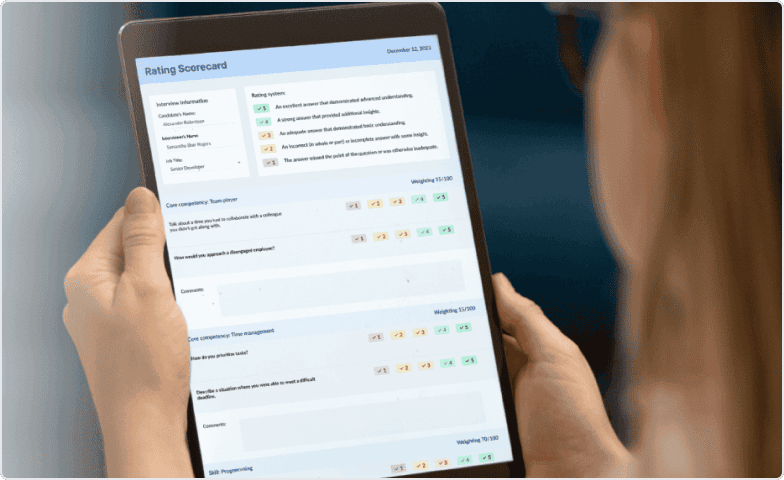
Pair every question with an interview scorecard that defines in advance what a strong answer sounds like. Then listen for patterns across answers, evidence of learning from past mistakes, and the attitude traits your top performers share.
Competency
Example question
Teamwork
"Tell me about a time you worked with a difficult team member."
Initiative
"Tell me about a time you went above and beyond. What was the outcome?"
Communication
"Describe a time you explained complex information to a non-expert."
Problem-solving
"Describe a time you solved a complex problem. What steps did you take?"
Leadership
"Tell me about a time you led a team through a challenging project."
Adaptability
"Describe a time you had to adapt quickly to a change at work."
Situational interview questions present a hypothetical, role-relevant scenario and ask the candidate how they would respond. Unlike behavioral questions, they assess critical thinking and judgment rather than recollection of past events.
They typically begin with "What would you do if," "How would you react if," or "How do you plan to." Because the candidate develops most of the answer in real time, the response reveals how they evaluate options, handle ambiguity, and find solutions under mild pressure.
Match the scenario to the competencies the role needs. Common categories and what each reveals:
Category
Example question
What the answer shows
Interpersonal
"A colleague misses a team meeting with no notice. How do you handle it?"
Balance of courtesy and accountability
Time management
"A client needs an urgent deliverable in two days, but you have three other deadlines. What do you do?"
How they manage competing priorities
Problem-solving
"You get a project with no clear direction. How do you get the details you need?"
Resourcefulness when information is missing
Leadership
A client requests features that extend the project by three weeks. How do you communicate the budget and timeline impact?
How they set expectations and negotiate scope
Ethics
"You learn a teammate shared confidential information with a competitor. What do you do?"
Judgment and principles under pressure
Score responses with an interview scorecard, and look for four things: relevant experience applied to the scenario, clearly communicated ideas, realistic solutions, and signs of growth from past challenges. Candidates can still use the STAR method here by grounding a hypothetical answer in a real example. As part of interview training, teach interviewers to listen for how the person identified the issue, weighed options, and reached a solution.
Competency-based interview questions assess how well a candidate displays the specific knowledge, skills, abilities, and behaviors that drive performance in a defined role. They are tied directly to the job and to your organization's values.
Two things must exist before you write them: a shared definition of what "competency" means in your organization, and a competency model you can build questions from. The Office of Disease Prevention and Health Promotion defines competencies as "the knowledge, skills, abilities, and behaviors that contribute to individual and organizational performance.
Use a job analysis to identify the competencies a role requires. A job analysis is a systematic process for determining a job's duties and requirements and how important each one is. You can run one by distributing a questionnaire, interviewing current staff, observing the work directly, or reviewing a work log.
Common competencies employers assess include accountability, collaboration, communication, customer focus, leadership, and integrity. Build a mix of organization-wide and role-specific competencies, then write one or two questions for each.

To write your own, pick a competency, define how it shows up in the role, draft a question that lets the candidate demonstrate it, and note what a strong answer looks like.
Illegal interview questions are questions that ask about legally protected characteristics rather than a candidate's ability to do the job. Unless a question is job-related and necessary to the operation of the business, asking about personal attributes can put your organization on the radar of the U.S. Equal Employment Opportunity Commission (EEOC) and expose it to complaints, investigations, and lawsuits.
Avoiding these questions is not only about risk. It produces a better candidate experience, more objective hiring decisions, and stronger employer branding.
Several U.S. federal laws govern discrimination in hiring:
Steer clear of questions about protected characteristics, including age, race, religion, national origin, marital or family status, pregnancy, disability, and genetic information. Bias often enters unintentionally through small talk, so train interviewers to keep every question tied to job requirements.
Most personal questions have a lawful, work-focused alternative:
Instead of asking
Ask
"How old are you?"
"Are you able to meet the schedule this role requires?"
"Do you have children?"
"Are you available to travel or work occasional overtime?"
"Where are you from?"
"Are you authorized to work in this country?"
"What religion do you practice?"
"Are you available to work our standard business hours?"
The most reliable safeguard is a structured interview: a fixed set of job-related questions asked of every candidate that keeps the conversation lawful and consistent.
The most common interview questions are broad, open prompts that nearly every candidate will face. Preparing for them in advance is the single best way to walk in confident. Below are six of the most frequent questions and how to answer each well.
Lead with your professional story. Aim for roughly 80% professional and 20% personal, summarizing your most relevant skills, experience, and education before adding one or two personal touches. Tailor it to the role so the interviewer immediately sees your fit.
Show genuine motivation and never criticize a current or former employer. Explain what drew you to the posting, how you see yourself fitting into the company's culture.
Sound capable without sounding arrogant. Name a concrete transferable skill and a soft skill, and back each with a brief example of how it helped at work.
Demonstrate that you did your homework. Speak to the organization's products or services, where it operates, its likely competitors, and its mission or values. If something is unclear, ask a thoughtful clarifying question.
Show that you plan ahead. Describe realistic professional aspirations and the steps to reach them, keeping the focus on growth within roles like the one you are interviewing for.
Treat this as your elevator pitch. Explain what sets you apart, how your background prepares you for the role, and a specific result you delivered in a similar position.

For more, read our guide on how to ace your video interview.
Candidates should always prepare questions to ask the interviewer, because asking none can signal a lack of preparation or interest. Research from Harvard Business School found a consistent link between asking questions, especially follow-ups, and being better liked by the other person.
Before choosing questions, research the organization, look up your interviewers, review the job description closely, and clarify your own goals. Then pick a few questions from each category below.
Avoid asking about anything already answered in the job description, practice your questions aloud, and watch the clock so you lead with what matters most.
A strong interview question set is structured, job-related, and scored the same way for every candidate. The pieces fit together in a clear sequence.
This is the core of structured interviews. Multiple studies show structured interviews improve hiring; the U.S. Office of Personnel Management notes they increase interviewers' agreement on evaluations by limiting individual discretion. Asking every candidate the same job-related questions and scoring them against the same standard is what mitigates the impact of hiring bias.
VidCruiter turns a question set into a repeatable, scorable process. Its structured interview platform standardizes the questions every candidate receives and pairs them with digital scorecards, so interviewers rate answers against the same rubric.
Capability
VidCruiter
Unstructured interviews
Same questions for every candidate
Yes, enforced by the interview guide
Varies by interviewer
Built-in scoring rubric
Yes, on every question
Rarely, often from memory
Recorded responses to rewatch
Yes, with video interviewing
No
Compliance guardrails
Yes, job-related question sets
Depends on the interviewer
Consistent, comparable data
Yes, stored for every applicant
Difficult to compare
VidCruiter's AI Candidate Screening rates the content of recorded answers against a client-approved rubric, and human reviewers keep final authority over every decision. AI Interview Notes generate a structured summary during the interview. Used this way, AI supports interviewers and helps mitigate the impact of bias rather than replacing human judgment.
VidCruiter is a strong fit for teams that interview at volume or in regulated sectors. Small teams running one or two informal chats a year may not need this depth, and that is a fair trade to name.

Common questions include "Tell me about yourself," "Why do you want this job?" and "What are your strengths and weaknesses?" These broad, open prompts appear in nearly every interview, so prepare answers in advance and tailor them to the role.
Behavioral questions ask about real past experiences ("Tell me about a time..."), while situational questions ask how a candidate would handle a hypothetical scenario ("What would you do if..."). Behavioral questions measure proven behavior; situational questions measure judgment and problem-solving. Strong interviews use both.
Illegal questions ask about legally protected characteristics such as age, race, religion, national origin, marital or family status, pregnancy, disability, and genetic information. In the U.S., these can trigger EEOC complaints. Ask the job-related version instead, such as work authorization rather than national origin.
STAR stands for Situation, Task, Action, and Result. Candidates describe the context, the objective they faced, the actions they took, and the outcome. The format keeps answers focused and gives interviewers a consistent structure to score against.
Prepare a fixed set tied to the role's competencies, typically a mix of five to ten behavioral, situational, and competency questions, plus predefined follow-ups. Asking every candidate the same set is what makes their answers comparable.
Candidates should ask about the role's challenges, how success is measured, team culture, and next steps in the process. Thoughtful questions signal preparation and genuine interest, and research links question-asking to being better liked by the interviewer.
Use a structured interview: ask every candidate the same job-related questions and score answers on a shared rubric, ideally with a diverse panel. Recording responses for later review also helps mitigate the impact of bias by allowing a second look.
Modernize your hiring process with expert insights and advice.