


What is an Applicant Tracking System?
Applicant tracking systems are crucial components to recruitment automation. Learn how in our guide.
SHARE THIS ARTICLE


An interview scorecard is a standardized form that lets interviewers rate every candidate against the same job-related criteria, so hiring decisions rest on evidence instead of gut feel. Hiring teams that use one make fairer, faster, and more defensible decisions, because each candidate is measured the same way and every rating is documented. This guide explains what goes into an effective candidate scorecard, how it differs from a rubric and an evaluation form, and how to build, use, and template one as part of a structured interview process.
Most employers interview 6 to 10 applicants per role, and many run 2 to 3 rounds for each, according to CareerSidekick. Across dozens of open roles, comparing candidates fairly becomes hard without a consistent way to score them. A scorecard solves that.
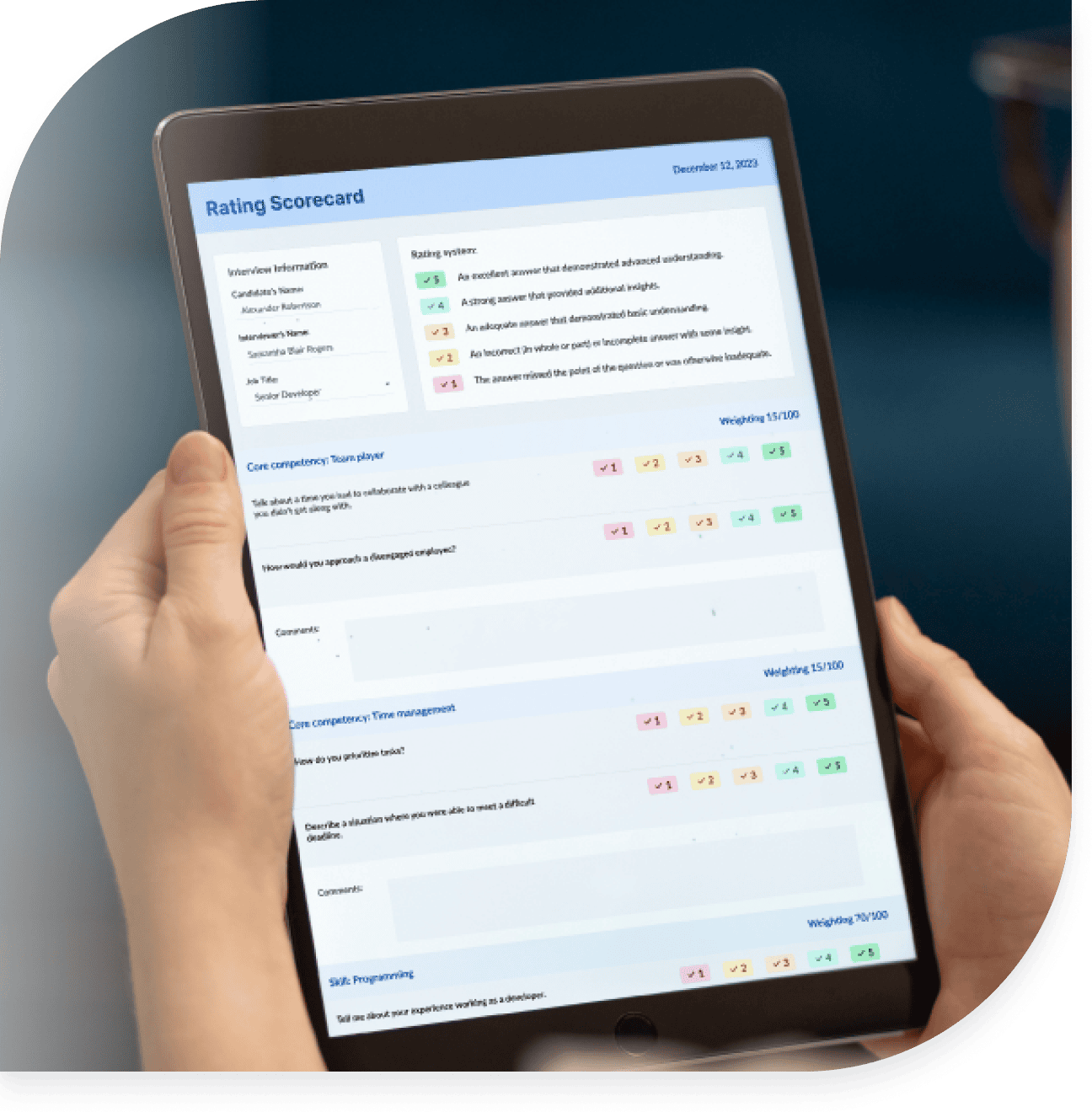
An interview scorecard is an assessment tool used within a structured interview process to standardize how candidates are evaluated. It lets interviewers score all applicants against the same predetermined competencies, recording whether each person demonstrates the skills a role requires.
Also called a candidate scorecard, scoring sheet, or recruitment scorecard, it usually sits inside an interview guide, which holds everything an interviewer needs to run a consistent interview for a specific position. Once every candidate has been interviewed and rated, hiring managers review the results, discuss the scores with any other panelists from a panel interview, and decide who advances.
Learn how to set up a structured interview process
These three tools are related but distinct, and they are often confused. The table below shows how each one differs.
Tool
What it is
When it’s used
Interview evaluation form
A general form for collecting interviewer feedback. Structure varies and may include open text, checkboxes, or ratings.
To gather overall impressions after an interview.
Interview scorecard
A type of evaluation form built for structured interviews. Ties ratings to specific competencies, with scales, notes, and a recommendation.
To rate responses consistently and record the result.
Interview rubric
A descriptive scoring guide that defines what a "3" versus a "5" looks like for each competency. Often built into the scorecard.
To anchor every rating to observable behavior.
In short, every interview rubric and scorecard is an evaluation form, but not every evaluation form is structured. The rubric defines the "why" and "how" behind each rating, while the scorecard is where the ratings are recorded.
Candidate scorecards benefit hiring teams in several ways when used as part of a structured interview process. The five below are the most consequential.
Scorecards assess everyone against the same criteria while accounting for accommodations, which makes the process fairer. They also support interview compliance by making it easier for interviewers at any level to follow the same method and harder to stray from it.
A scorecard is formal documentation that makes decisions more legally defensible. Rating data can show why a candidate was chosen and demonstrate that the choice was job-related, which helps guard against adverse impact and discrimination claims.
A well-designed scorecard gives interviewers a far better chance of selecting a strong candidate. Because it is part of a structured interview process, it inherits that method's accuracy: McGill University found structured interview reliably predict future job performance. Scoring only what relates to the role produces better data and better decisions
Building a scorecard helps everyone align on what an ideal candidate brings to the role. In a panel interview, standardized ratings make scores easy to compare, and differing scores open a focused discussion about who should advance and why.

Standardization gives every candidate a repeatable, objective evaluation, which mitigates the impact of bias on hiring decisions. Pairing the scorecard with interview questions that predict performance also speeds up decisions, since the most predictive questions can be weighted more heavily when candidates score closely.
A good scorecard mirrors the findings of a job analysis, which outlines the competencies and requirements a role actually needs. The scorecard is the companion to the interview guide: the guide keeps each interview consistent, and the scorecard captures feedback consistently.
The strongest scorecards share five components:
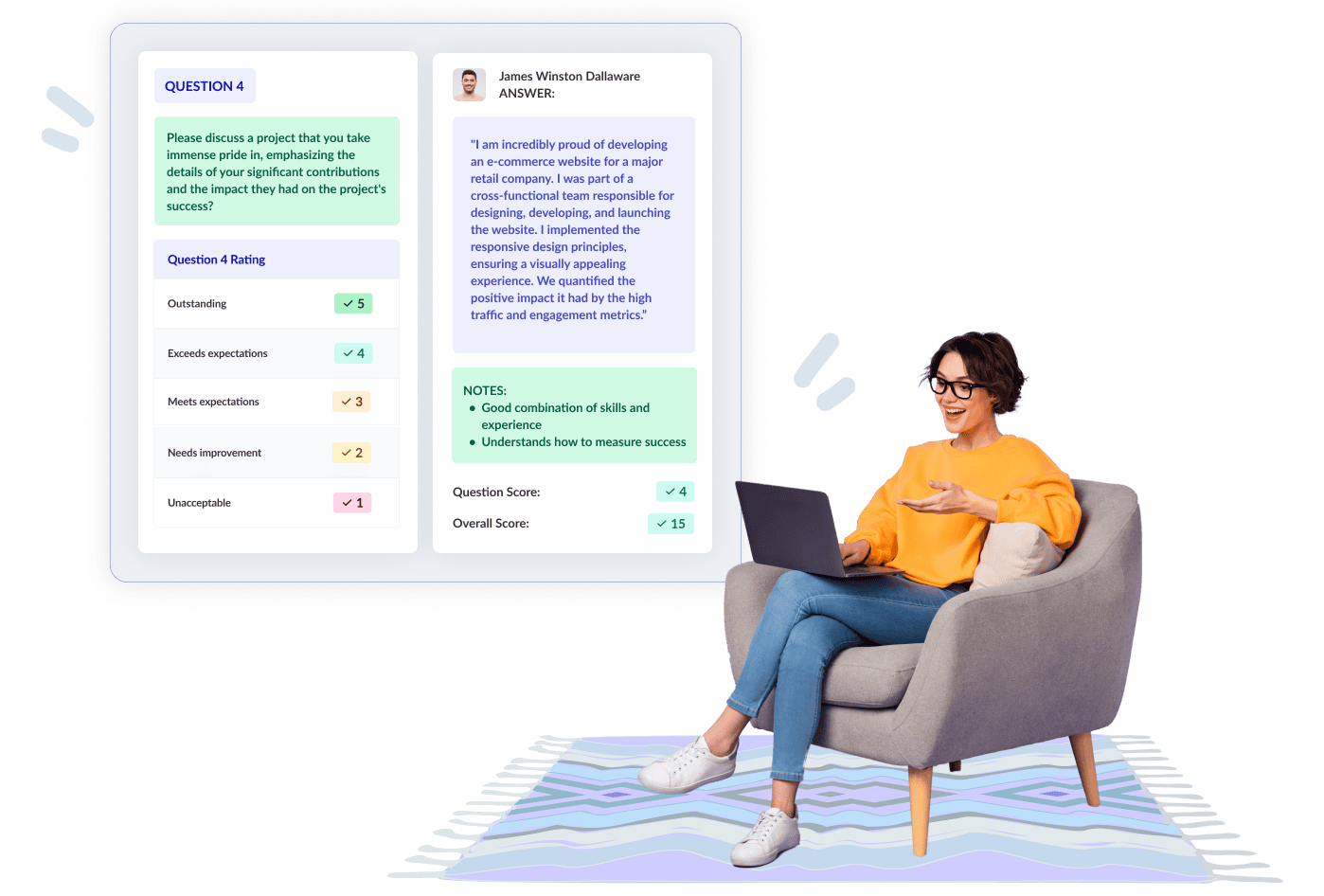
Behavioral indicators are what separate a usable scorecard from a vague one. Rather than rating "potential," interviewers score observable evidence, such as a specific example or story. A "5" in communication might read "clearly structures complex ideas and adapts tone to the audience," while a "2" reads "struggles to organize thoughts or give examples." Pairing the scorecard with behavioral interview questions or competency-based interview questions gives interviewers a structured way to surface that evidence.
Every scorecard needs a consistent rating scale so interviewers score responses the same way. Three are common in hiring.
A Likert scale measures opinions, perceptions, and behaviors, with each number describing a competency level in detail. A behaviorally anchored rating scale (BARS) asks interviewers to compare a candidate's described behavior against examples sorted by competency level, usually 1 to 5, with descriptions drawn from real situations. A behavioral observation scale (BOS) works similarly and is used with situational questions to evaluate performance.
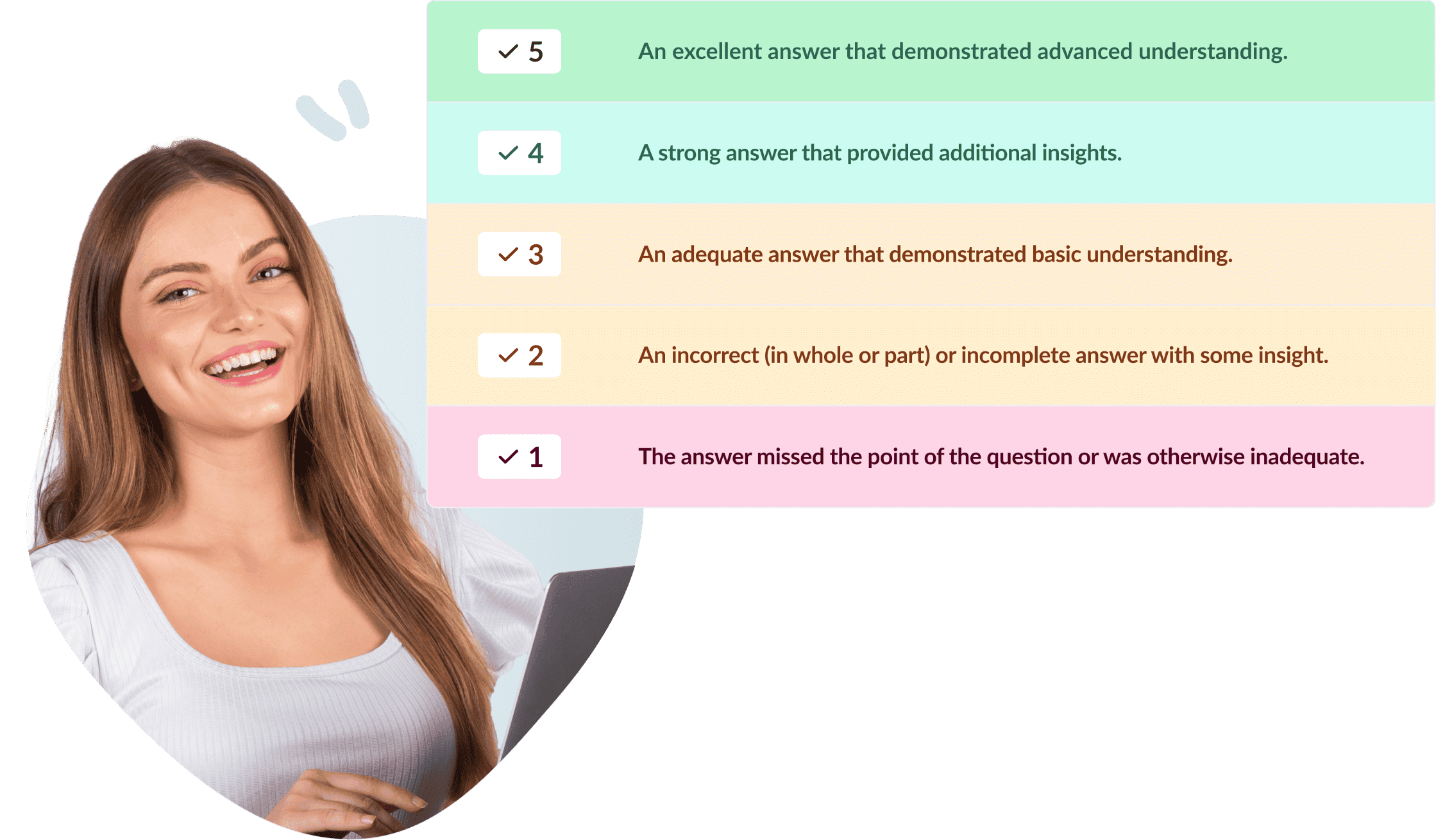
A 1 to 5 scale is the most widely used, where 1 reflects minimal demonstration of a skill and 5 reflects mastery. Defining what each level means keeps interpretation consistent, even when interviewers phrase their notes differently.
An interview scorecard template lets hiring teams across an organization adopt repeatable practices, and each role-specific template becomes a head start the next time you hire for that job. Follow these steps.
Scorecards do not work in isolation. They are part of a structured interview process, so secure buy-in for structured interviewing first if your organization is not already using it.
Each role has its own requirements for success. A job analysis, which the U.S. Office of Personnel Management calls the foundation for all assessment and selection decisions, guides both the interview guide and the scorecard.
Identify the skills, traits, and competencies that drive success in the role, using job descriptions, performance data, and input from current high performers. Keep the list focused, since too many criteria dilute scoring clarity. Replace vague traits like "team player" with measurable criteria such as collaboration or problem-solving under pressure.
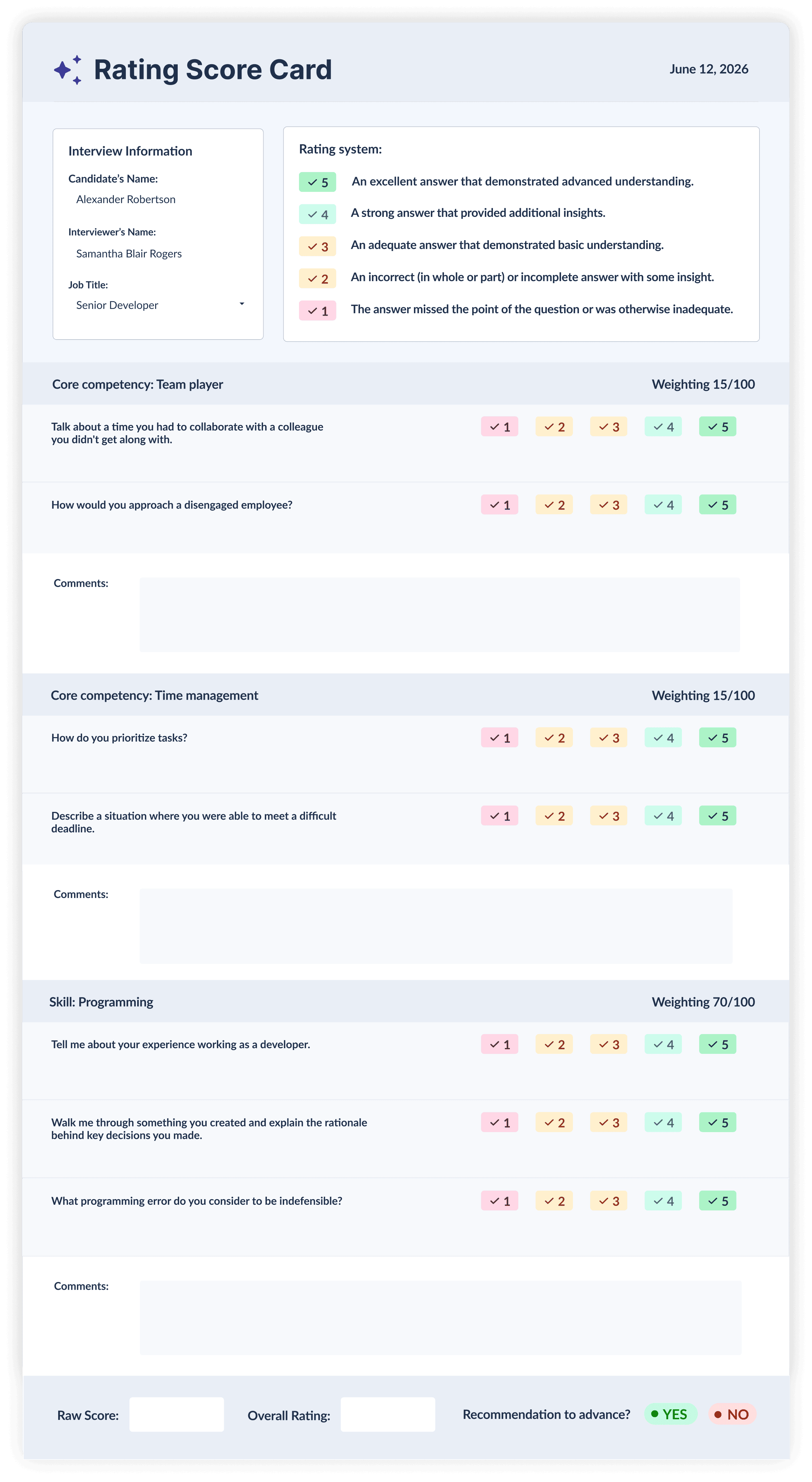
Lay out placeholders for the job description, questions mapped to four to six role-related competencies plus one or two organizational categories, ratings for each response, comment space by question, a raw score, and an overall recommendation that weighs the score alongside notes and interviewer judgment.
Create a scale that describes each performance level in behavior-based language rather than terms like "excellent" or "poor." Note that not every role needs a candidate who scores high across the board. A strong marketing hire might score a 3 in paid advertising but a 5 in communication, which can signal growth potential. Define the balance that fits your organization.
Decide how you will aggregate the data, whether by spreadsheet or a digital scoring tool that compiles results automatically. Then set the advancement rule in advance: a minimum score, or the top three to six candidates. Adjust as needed once a hiring round closes.
Even careful teams undercut fairness when a scorecard is built poorly. Watch for these three mistakes.
A long list feels thorough but leads to scoring fatigue, and interviewers juggling ten or more criteria fall back on instinct. Keep it to the five to seven competencies that define success for the role. Daniel Kahneman, author of Thinking, Fast and Slow, has argued that evaluators should focus on roughly six dimensions, since too many data points push judgment back toward intuition.
Phrases like "strong communicator" mean different things to different interviewers. Replace them with observable indicators, such as "clearly structures answers and provides relevant examples," so ratings anchor to evidence rather than impressions.
A scorecard should evolve. If interviewers or candidates are confused by a question or criterion, treat it as a signal to refine. Review scoring patterns regularly and adjust criteria or scale definitions where interviewers diverge, as part of your interview training and calibration routine.
Creating a scorecard is not enough; how it is used determines how well it works.
The most accurate time to complete a scorecard is during the interview, rating each answer before moving to the next question. According to a Harvard Business Review analysis by Iris Bohnet, rating as you go guards against memory biases that favor vivid or recent answers, and against rewarding candidates whose strength is storytelling. In a panel interview, each interviewer should rate independently before any discussion to keep scores uncorrupted.
Four habits keep scoring fair and consistent
The layout below shows a simple 1 to 5 scale with behavioral indicators for three sample competencies. Adapt the competencies and descriptions to each role, whether you start in a spreadsheet or use a structured interview software platform.
Rating
Cultural fit
Adaptability
Motivation
5
Clearly demonstrates values aligned with the mission; examples provided
Embraces change; flexible and proactive
Self-motivated; goes above and beyond
4
Values mostly align; some examples
Adapts well; occasional hesitation
Motivated; completes tasks reliably
3
Some alignment; limited examples
Adapts with some guidance
Meets expectations; limited extra effort
2
Little alignment; vague examples
Resistant to change; slow to adapt
Minimal initiative; needs supervision
1
Values conflict with culture
Inflexible; does not adjust
Lacks motivation; avoids responsibility
Software makes a scorecard easier to apply the same way every time. When scorecards and rating scales live inside a structured interview platform, they stay consistent across interviewers, roles, and departments.
The platform gives every candidate the same questions, timing, and scoring framework, whether the interview runs through pre-recorded video interviews or live video interviews. That consistency removes unintended variation between interviewers.
Digital scorecards record who completed each evaluation, when, and how criteria were applied, creating a defensible audit trail. Using AI interview notes captures responses automatically and organizes them next to scores, so evaluators spend less time on documentation. Storing scores in one interview management system keeps everything together for review. Legal analyses note that courts increasingly hold organizations and their vendors accountable when hiring tools produce biased or unvalidated outcomes, which makes thorough documentation more important.
With scores stored centrally, hiring teams can see which competencies predict success and where interviewers need calibration. Using interview intelligence to surface scoring tendencies that may reflect unconscious bias lets teams coach interviewers and refine the process over time.
An interview rubric defines how candidates are assessed, with criteria, scale definitions, and behavioral indicators, while a scorecard is the form where those ratings are recorded. In practice, the rubric is built into the scorecard: the rubric sets the rules, and the scorecard captures the results.
An interview scorecard should include job-related competencies, a rating scale or rubric, space for notes, an overall score, and a recommendation on next steps. Every element should map back to a structured interview guide and a job analysis so evaluations stay fair and consistent across candidates.
The most reliable scoring methods are Likert scales, behaviorally anchored rating scales (BARS), and behavioral observation scales (BOS). Each gives interviewers a structured, repeatable way to rate responses and limits subjectivity in the evaluation.
Yes. Using the same scorecard across interviewers keeps evaluations consistent and makes candidates comparable across panels. It is also what makes structured, equitable hiring decisions possible in the first place.
Yes. By standardizing evaluation and prompting interviewers to rate each response in real time against defined criteria, scorecards mitigate the impact of unconscious bias and create a fairer, more objective process that is easier to defend.
Score candidates objectively by applying the same criteria and rating scale to everyone, and by tying each rating to concrete evidence from the candidate's responses. Independent, real-time ratings backed by behavioral indicators keep scores grounded in what was said, not in impressions.
Fill out an interview scorecard during the interview, rating each answer before the next question. Scoring in real time prevents memory bias from favoring the most recent or most vividly described answers, and keeps every rating tied to specific evidence.
A resume score is based on a candidate's resume rather than their interview answers. Many applicant tracking systems use AI to organize resumes and suggest a shortlist. Speeding up screening this way is useful, but leaving advancement decisions entirely to AI is high risk, since the data may be biased and the reasoning hard to audit.
E-BOOK
The Modern Guide to Structured Interviewing
Get your free copy of VidCruiter’s comprehensive white paper about structured interviewing. This practical guide:
 Shows you how you can use technology to optimize your hiringTeaches you how to develop and conduct a structured interview process
By providing email address, you agree to receive updates from VidCruiter.
Read our Privacy Policy
Modernize your hiring process with expert insights and advice.