

How to Conduct Panel Interviews
Run effective panel interviews with clear roles and shared criteria.

SHARE THIS ARTICLE


A job analysis is the structured process of documenting what a role does, the competencies it requires, and the conditions it operates in. Hiring teams use it as the factual foundation for job descriptions, structured interviews, and fair pay decisions. Get it right and every later step of the interview process stays job-relevant; skip it and you end up evaluating candidates against assumptions instead of evidence. This guide explains what a job analysis is, how it differs from job evaluation, the main methods and data-collection techniques, a step-by-step process, a reusable template, and a practical example.
A job analysis is a formal method for collecting and analyzing information about a job role. It breaks a position into smaller parts, such as individual tasks and required skills, using a repeatable method for gathering and synthesizing data. The U.S. Office of Personnel Management puts it plainly: "Job analysis is the foundation for all assessment and selection decisions."
The information a job analysis captures falls into four areas:
A qualified HR practitioner, job analyst, or consultant usually leads the process, working from a clear picture of the organization's hiring goals. This job analysis definition holds across industries and situations, from introducing a single new role to mapping every position before a restructuring.

A job analysis matters because hiring decisions are only as good as the information behind them. Without a clear record of what a role requires, teams interview against guesswork, write vague job descriptions, and set pay inconsistently. Four reasons make the process worth the effort.
Operational context. A complete view of a role lets you stop second-guessing and act with evidence. You can give candidates a realistic job preview and build a training plan that matches the actual work.
Organizational impact. The better you understand each role, the more deliberate your decisions become. A job analysis surfaces the differences between similar positions and shows how a role connects to the teams around it.
Role definition. Some hiring managers do not see the full picture of a position they oversee, which leads to weak hiring decisions. A job analysis clarifies expectations, validates pay bands, and informs the people making the call.
Clear role requirements. A job analysis defines the competencies a strong candidate needs, the minimum qualifications to perform the role, and which competencies are non-negotiable. That clarity improves both who you hire and who you keep.
Researcher Parbudyal Singh, writing in Human Resource Management Review, describes job analysis as a lasting and important tool in human resource management, one he expects to stay central for the foreseeable future.
Job analysis and job evaluation are related but separate processes, and teams often confuse them. A job analysis documents what a role involves. A job evaluation determines a role's relative worth to the organization so it can be placed correctly in a pay structure.
The two connect in sequence. A job analysis comes first and produces the facts: the tasks, competencies, and responsibilities of the role. A job evaluation then uses those facts to compare the role against others and assign it a grade or salary band. You cannot run a credible job evaluation without job analysis data underneath it.
Job evaluation generally follows one of four established approaches:
In short, job analysis answers "what does this role do?" while job evaluation answers "what is this role worth relative to others?" Most organizations need both, and the analysis always comes first.

Job analysis data supports a structured hiring process and several functions beyond it. The data divides into three categories: activities, competencies, and context.
Activities describe what the role does and is responsible for, including its tasks, duties, and core functions. Competencies cover what a person needs to perform well: knowledge, skills, abilities, behaviors, and other characteristics. Context describes the work environment, including supervision given and received, working conditions, internal and external interactions, and the equipment, tools, and software the role uses.
Within hiring, that data shapes three deliverables:
Job specifications. A job analysis clarifies the education, work experience, and certifications a candidate needs to qualify, and separates must-have requirements from skills a new hire can learn on the job.
Detailed job descriptions. Vague postings drive qualified candidates away. According to Burnett's Staffing, being too vague is the single most common mistake employers make when writing a job description. A job analysis supplies the specifics that make a posting clear and the role attractive, and it feeds the interview guide and interview questions used later.
Selection assessments. A job analysis reveals which tasks and competencies matter most, so you can build assessments that test the right things and choose between competency-based and task-based methods.
Outside hiring, organizations also use job analysis data to meet legal requirements, identify health and safety hazards, find training gaps, support employee development, set compensation grades, and inform promotions and performance reviews.
Several formal methods exist, and some suit hiring better than others. A study in the Academy of Management Journal compared methods against one another and found that the choice of method changes the result, so the right pick depends on your goal. The table below summarizes six common methods and where each fits.
Method
Description
Best use case for hiring
Functional Job Analysis (FJA)
Defines the work activities, responsibilities, and qualifications needed to perform a role, focusing on specific tasks rather than outcomes.
Writing job descriptions
Task Inventory (TI)
A structured list of every task in a role, scored for frequency, importance, and difficulty, completed jointly by managers and employees.
Job descriptions and job classification
Threshold Traits Analysis (TTA)
A collaborative method where people who know the role rate the importance, relevance, and practicality of 33 traits.
Personnel requirements and job classification
Job Elements Method (JEM)
Compares applicants' abilities against job requirements to identify eligibility and the attributes tied to top performance.
Personnel requirements
Critical Incident Technique (CIT)
Identifies the specific behaviors that lead to effective or ineffective outcomes on the job.
Performance reviews and feedback
Position Analysis Questionnaire (PAQ)
A standardized questionnaire covering hundreds of job elements across five categories, used to compare positions quantitatively. According to HR Guide, it draws on data from thousands of jobs.
Job classification and job evaluation
In many cases the strongest approach combines methods, since each one answers a slightly different question about the role.
Most HR teams use a mix of data-collection techniques rather than a single one. Each technique captures a different angle on the role.
Work log or diary. The employee records their daily activities for a set period, noting each task, the time spent on it, and its perceived importance or urgency.
Observation. A manager, HR practitioner, job analyst, or consultant watches an employee perform their tasks without taking part, which gives a realistic view of the work and its context.
Questionnaires. Questionnaires are among the most affordable and accessible options. O*NET offers generic, structured questionnaires that current employees or people who know the role can complete as a starting point for collecting occupational data.
Competitive research. Review how comparable organizations describe similar roles, including titles, requirements, and duties, to calibrate what the most relevant expectations are.
Interview. A job analysis interview is an in-person or video conversation with someone who currently holds the role, or held it in the past. The interviewer leads with predetermined questions and captures the employee's perspective; interviewing more than one person gives a fuller view.
Job performance. A job analyst performs the work themselves to experience the role's stressors, physical demands, and real scenarios first-hand. This goes deeper than observation, because the analyst is doing the job rather than only watching it.

You conduct a job analysis in five steps that move from documenting the role to keeping it current. The steps below cover most job types; complex or highly technical roles may need additional rounds.
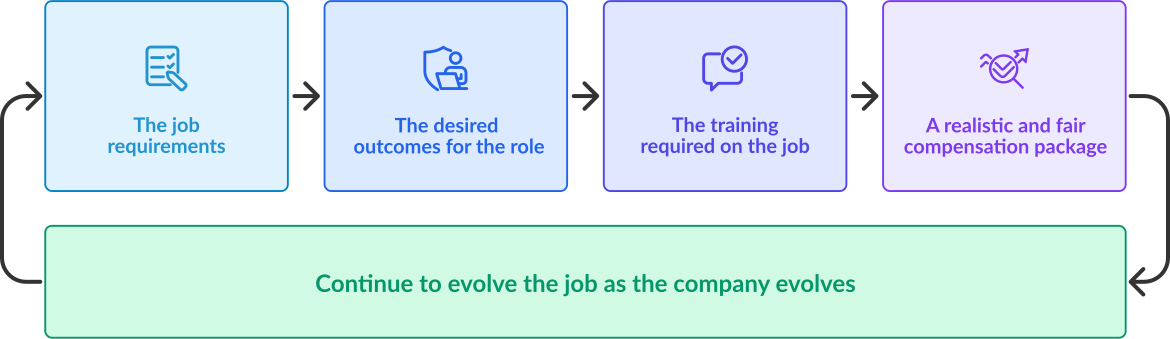
Define the role's duties, responsibilities, and expectations. Capture the day-to-day tasks and the difficulty and importance of each, the other responsibilities, the skills needed to succeed, and the qualifications and experience required.
Best techniques: work log, observation, interview, job performance.
Look at the bigger picture of how the position serves the organization. Document how the role aligns with company goals, how it contributes to cross-team projects, the soft skills it needs, its 30-60-90 day goals, and how success will be measured over time.
Best techniques: questionnaires, interview, job performance.
Determine what a new hire needs to reach short- and long-term success. Note onboarding requirements, role-specific product or service training, and any training for the programs and tools the role uses, along with who will deliver it and how long it takes.
Best techniques: work log, questionnaires, interview.
Pulling the earlier steps together lets you set pay with evidence. Define a fair salary range for the role and experience level, the benefits, how the band compares to similar internal roles, and how it compares to the external market.
Best techniques: competitive research, internal comparisons.
A job analysis is not a one-time task. Roles change as the organization, industry, and economy shift. Refresh fast-moving or technology-heavy roles roughly once a year, and review stable roles as needed. Analyzing every role together, rather than one in isolation, often reveals overlapping responsibilities you can resolve.

A job analysis template should capture the role's identity, work, requirements, and context in a single reusable document. A consistent template makes roles comparable, which is what later steps such as job evaluation and structured interviewing depend on.
A practical template includes the following fields:
Store completed templates in a shared library so every role uses the same structure and language. That consistency keeps hiring and pay conversations aligned as the organization grows.
A job analysis example is easiest to follow with a filled-in role. The summary below applies the template fields to a Customer Support Representative.
From this one record, the team can write an accurate job description, build interview questions tied to each competency, design a relevant skills test, and set a defensible pay band, all from the same source of truth.
A job analysis is the natural first step in a structured hiring process, because it tells you exactly what to evaluate candidates against. The competencies and tasks it surfaces become the criteria for your interview questions, your rating scales, and your scorecards. Without that grounding, even a well-run interview measures the wrong things.
The connection is direct. A structured interview asks every candidate the same job-relevant questions and scores them on the same scale. The job analysis defines which questions are relevant and what a strong answer looks like, so the evaluation stays consistent and fair across candidates. This is also why structured interviews are one of the better ways to mitigate the impact of bias: the criteria are set in advance from the role itself, not improvised in the room.
VidCruiter helps teams put that structure into practice. Its structured interview tools turn job analysis findings into standardized guides, questions, and scoring rubrics, and connect them to skills testing and interview scorecards so the whole process traces back to the role you analyzed.
Start conducting structured interviews Learn how to conduct a structured interview or request a demo.

A job analysis is the internal process of gathering information about a role's tasks, competencies, and context. A job description is the external, written statement that advertises the role to job seekers, including the title, duties, required competencies, and working conditions. The analysis produces the raw information; the description is one of its outputs.
A job analysis documents what a role involves, while a job evaluation determines a role's relative worth so it can be placed in a pay structure. The analysis comes first and supplies the facts; the evaluation uses those facts to set the grade or salary band. Most organizations run both, in that order.
Conduct a job analysis when you introduce a role unlike any other at your organization, combine several jobs into one, restructure a team or department, change your organizational values, see the nature of the work shift, or need to revisit compensation. Any major change to a role or its place in the organization is a trigger.
Refresh fast-changing or technology-heavy roles roughly once a year, since their tasks and tools evolve quickly. Stable roles can be reviewed only as needed, when duties or requirements change. Keeping the analysis current keeps job descriptions, expectations, and pay accurate.
A qualified HR practitioner, dedicated job analyst, or external consultant usually leads a job analysis, working alongside the role's manager and the employees who currently do the job. Involving people who know the role well, plus those in adjacent positions, produces a fuller and more accurate picture.
A job analysis can take anywhere from a few days to several weeks, depending on the role's complexity, the number of methods used, and how many people are involved. A single straightforward role analyzed by questionnaire and interview is fast; a technical role analyzed through observation, work logs, and job performance takes longer.
A competency model is a defined set of the knowledge, skills, abilities, and behaviors a role requires. A job analysis is how organizations build that model, because the analysis identifies which competencies matter and how important each one is. The model then guides hiring, development, and performance management.
Software does not replace the analysis itself, but it carries the findings into the rest of hiring. Once a job analysis defines the competencies for a role, platforms like VidCruiter turn them into structured interview guides, standardized questions, rating scales, and scorecards, so candidates are measured against the role you analyzed.
A job analysis is not universally mandated, but it provides the documented, job-relevant basis that defensible hiring and pay decisions rely on. Especially in regulated and public-sector settings, a current job analysis supports compliance by showing that selection criteria and compensation tie directly to the role's actual requirements.
Modernize your hiring process with expert insights and advice.