
How To Schedule Interviews
Simplify the process to create a great candidate experience for both the hiring team and candidates. Learn how.

SHARE THIS ARTICLE


TL;DR
Remote panel interviews can be one of the fairest and most efficient ways to hire. Bringing multiple perspectives into a single decision reduces individual bias, and also alleviates costs and the disruption of interview travel for candidates, according to research published in the National Library of Medicine.
The challenge for everyone is coordination. Without the right technology, the administrative burden of managing interview panelists and candidates across locations and time zones can take over, and the actual evaluation suffers for it. The right remote panel interview tool removes this friction and allows hiring teams to focus on the main event: finding the right person for the role.
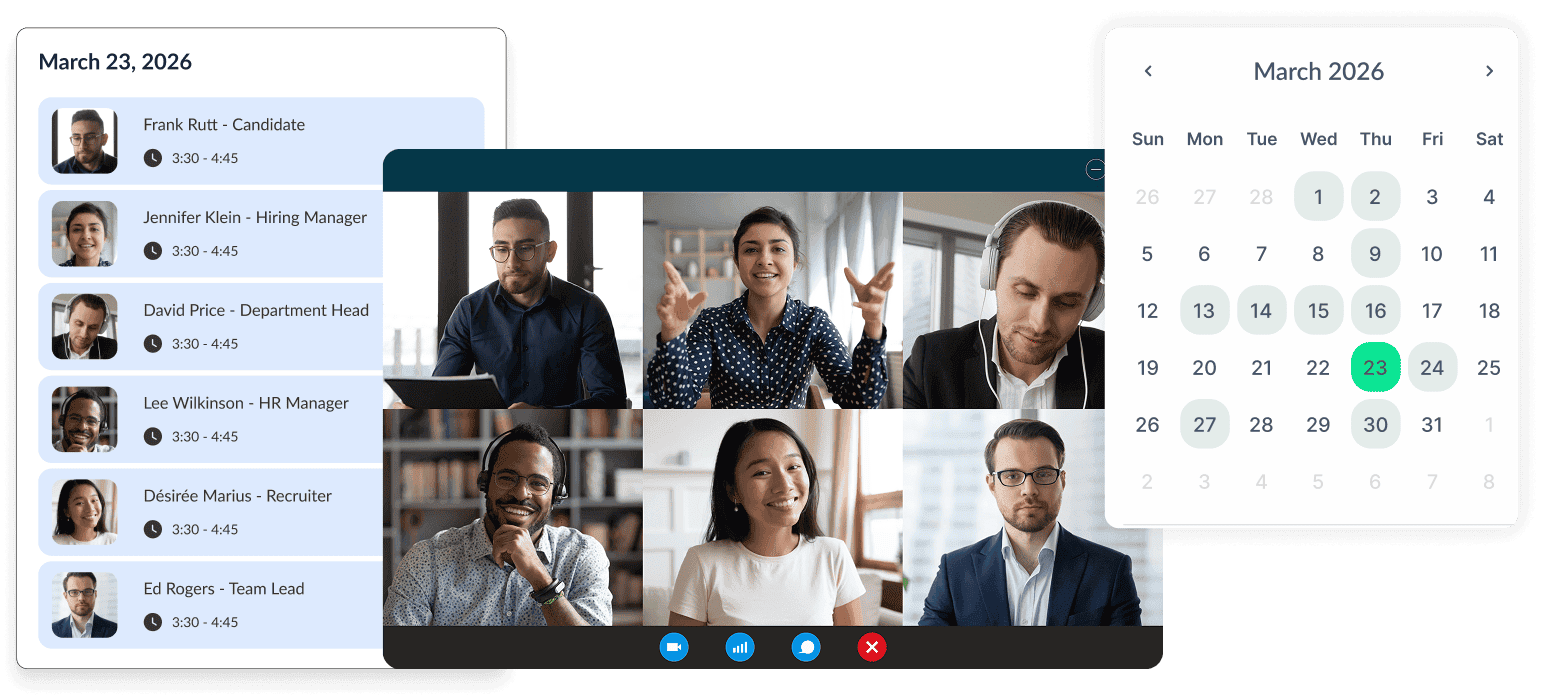
Traditional in-person interviews once centered on booking a meeting room and gathering everyone in one place. But in a remote setting, panel interview logistics present new coordination challenges.

Scheduling a panel interview in distributed setups means finding a time when every interviewer is available — a challenge when each panelist has their own calendar commitments, working hours, and local time zone to consider. Coordinators often need to cross-reference availability manually and manage multiple rounds of outreach before confirming a single interview slot. Even small changes, such as one interviewer needing to reschedule, can force the entire process to start again, creating delays for hiring teams and candidates.
Panel interview coordination often relies on separate systems that don’t share information with each other. HR.com’s State of Today's HR Technology and Integrations report found that one in five HR professionals use at least five separate platforms, including recruiting-specific tools to manage their HR processes. In an overcrowded tech stack, interview schedules may live in one calendar, while interview links and candidate evaluations are stored elsewhere. Coordinators must flip flop back and forth between platforms to manage each step. This lack of continuity makes it harder to maintain oversight and increases the likelihood of delays or incomplete feedback.
The main point of hosting a panel interview is to invite multiple perspectives into the hiring decision. Yet, this approach can introduce inconsistency when each interviewer evaluates candidates differently. Without a shared framework, panel members may focus on different competencies, or interpret responses differently, based on hiring biases, such as affinity bias, or the halo and horns effect.
Feedback collected in separate systems can further complicate comparisons, making it harder for hiring teams to reach clear, evidence-based decisions and increasing the risk of subjective or unfair evaluation.
Hiring decisions depend on timely input from every stakeholder, but access to interview materials can be limited or inconsistent. Panelists may miss a live interview due to scheduling conflicts or struggle to locate recordings and candidate information afterward.
Hiring teams may also store candidate feedback in different places or submit it at different times. Without a clear, centralized view of interview access and evaluation progress, coordinators must follow up manually, which slows decision-making and reduces transparency across key stakeholders.
Remote panel interview tools are a purpose-built solution that helps hiring teams coordinate, conduct, and evaluate candidates, even when interviewers are working from different locations. Instead of attempting to manage interviews using a selection of disparate tools, remote panel interview software centralizes scheduling, video interviews, evaluation, and feedback into a single system. From here, panelists can access interview materials and offer their input without any manual coordination.
Alongside the obvious advantages that remote panel interview software provides to hiring teams, these tools also play an important role in engaging candidates.
Elevate the Candidate Experience
Over half of applicants are unlikely to accept a job offer after a poor candidate experience, according to Korn Ferry research.
When every aspect of the interview exists in the same space, hiring teams can deliver a more organized and responsive process that reflects well on the employer and supports better hiring outcomes.
The best panel interview solutions share a common set of features that streamline candidate evaluations effectively across distributed hiring environments. As part of the software vendor research, look for tools with the following functionality, all of which is available in VidCruiter.
Coordinating panel availability shouldn’t require constant follow-ups or manual calendar checks. When scheduling tools are part of a collaborative interview platform, hiring teams can manage panel availability and interview timing in tandem. The following features reduce coordination effort and keep panel interviews moving forward.
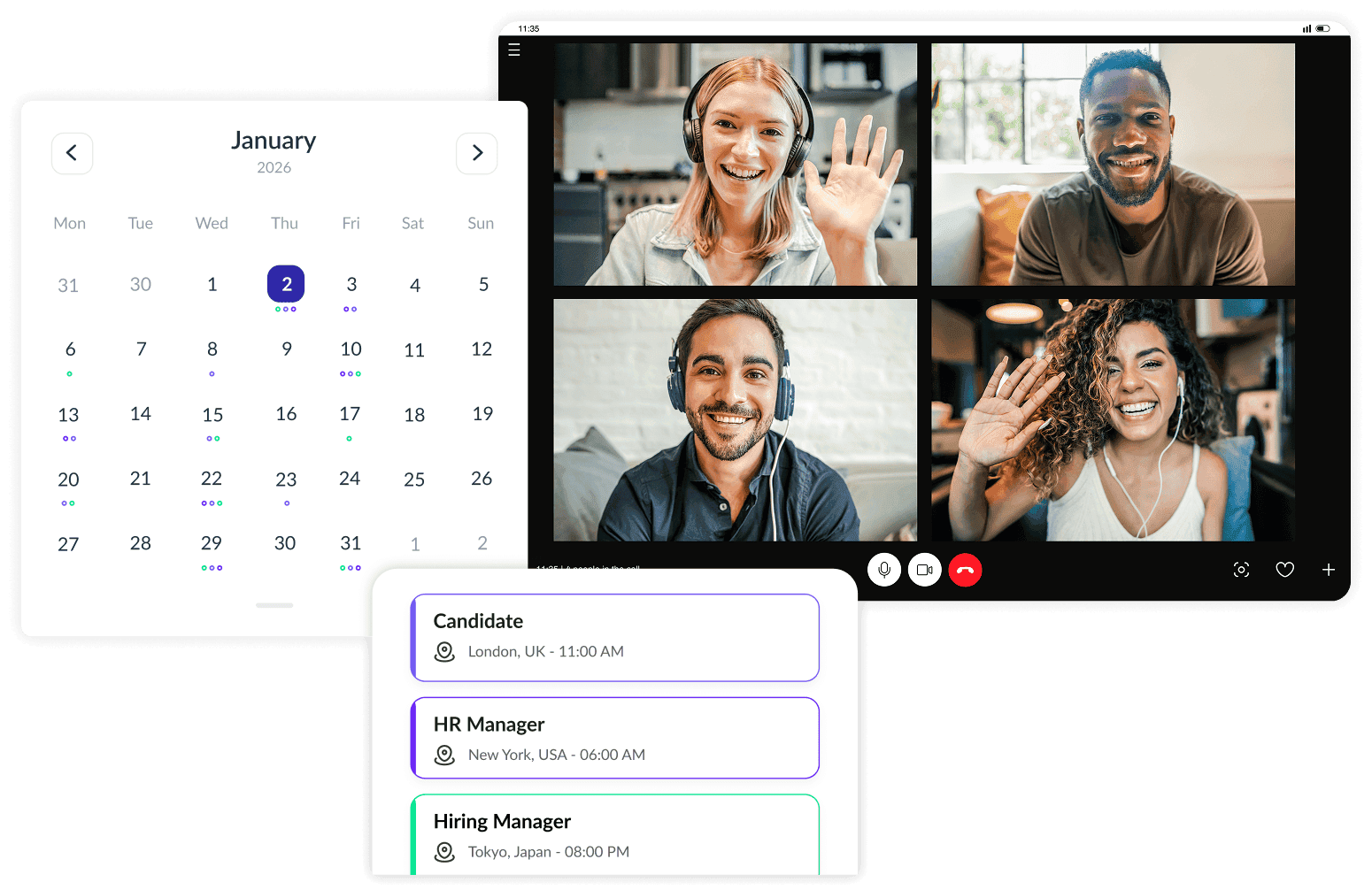
Not every panelist will be available at the same time, especially when hiring teams are juggling time zones and busy schedules. The best platforms are versatile, allowing hiring teams to coordinate effectively without delaying the process. Look for platforms that support a mix of interview formats.
As panel interviews generate input from multiple stakeholders, hiring teams need a clear way to capture and compare feedback from all parties. When evaluation tools are baked into the interview platform, panelists can document their observations in a fair, structured format that’s easy to review later. The following features make sure that interview feedback is accessible and comparable throughout the decision-making process.
Hiring teams often fall into the trap of committing to new tools that promise to improve efficiency. As hiring needs change shape, and even more solutions appear in the market, they feel tempted to continuously layer tools on top of tools to fill specific gaps. Suddenly, organizations are dealing with a stack of fragmented tools that don’t work in harmony. While each solution serves its particular purpose, coordinating panel interviews across a heap of systems increases administrative effort and makes interview progress harder to track.
As an integrated alternative, virtual interview panel software brings scheduling, interview access, recordings, and evaluation under one hood, so coordinators and panelists can work within a shared environment.
The Case for Integrated Technology
Research from the World Journal of Advanced Engineering Technology and Sciences shows that integrated HR technology can improve process efficiency by up to 55% and reduce manual administrative work.
When panel interview coordination happens within one system, hiring teams benefit from:
Panel interview coordination doesn't have to be the hardest part of hiring. With the right infrastructure in place, the focus shifts back to finding the right person for the role.
VidCruiter has been helping organizations run better panel interviews for over a decade. The platform was built for the reality of modern hiring, covering the entire panel interview lifecycle, so hiring teams no longer have to coordinate decision-making across disconnected systems. Scheduling, interview access, recordings, and evaluation all coexist, giving hiring teams a clear and reliable foundation for panel interview coordination.
If your current setup is creating more work than it should, it might be time to see what a purpose-built solution looks like in practice. Request a VidCruiter demo to explore how it could fit your hiring process.

Most remote panel interviews include three to five interviewers. This allows hiring teams to assess different competencies without overcomplicating anything. Using a multi-interviewer video interview platform allows each panelist to participate, access interview materials, and provide structured feedback within a single, coordinated process.
If a panel interviewer can’t attend because the interview falls outside their working hours, for example, they can review a recording and submit feedback afterward. Modern panel interview scheduling software makes it easy to share recordings, manage interviewer access, and collect evaluations in one place, so hiring decisions can move forward without rescheduling the candidate.
To prepare for an online panel interview, hiring teams should confirm that every panelist can access the interview session and decide in advance who’ll cover which topics. Remote panel interview tools make this easier by giving interviewers a shared place to review candidate details, record feedback, and stay connected and in discussion before and after the interview.
Yes, the best remote hiring panel tools support live and asynchronous interview formats. Live interviews allow panelists to meet candidates in real time, while asynchronous interviews let panel members contribute to the evaluation process at a time that suits them. This flexibility makes it easier to coordinate distributed hiring teams and collect complete evaluation feedback.
Modernize your hiring process with expert insights and advice.