

Job Analysis
The upstream step that informs every job description.

SHARE THIS ARTICLE


Making a job description means writing a document that lists a role's duties, required qualifications, and working conditions, and shows how the role supports the organization's goals. It is one of the first steps when you open a new position, and it sets the tone for the entire hiring process.
If you have ever asked, "How do I create a job description that attracts the right people?", this guide breaks down each part of the document and gives you a repeatable process you can follow for any role. The most accurate descriptions start with a job analysis, which records what the role actually involves before you write a word. Whether you lead a team, run a business, or support hiring managers across departments, the same approach applies.
A job description is a written summary of a role's duties, required skills, qualifications, and working conditions. It explains what a person in the role does day to day and how that work connects to the organization's goals.
A job description is not the same as a job posting. The description is the internal source document that defines the role. The posting is the public, marketing-facing version you publish to attract applicants. You write the description first, then shape a posting from it.
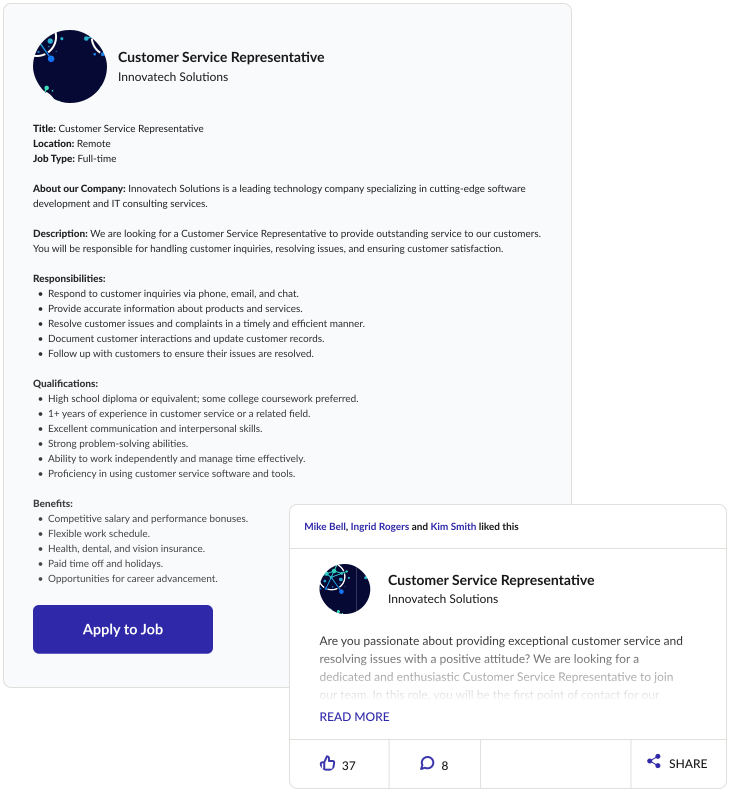
Job descriptions matter because they serve both the people you hire and the people who manage them. Used externally, they attract suitable candidates by stating the role, the requirements, and the reasons to work for you. Used internally, they guide employees, set a reference point for performance, and support training.
A well-written job description does five things:
A job description has five parts: the job title, the job purpose, the job description duties and responsibilities, the required qualifications, and the working conditions. Each one helps candidates decide whether the role fits and helps you attract the right applicants.
A job title should state what the role does in clear, searchable language. Indicate the seniority level and use standard industry terms. "Marketing Manager" works better than "Growth Guru" because more candidates search for it and understand it at a glance.
The job purpose explains why the role exists and how it contributes to the organization's goals. Keep it to one or two sentences, written in a motivating but honest tone. It gives daily tasks context without overstating the role.
Job description duties and responsibilities outline what the employee is expected to do, from daily tasks to yearly objectives. List the most important duties first, and consider using percentages to show how time is split across them. Be realistic about workload, since an overloaded list discourages strong candidates.
What does Gen Z look for in a job description?
According to a 2023 report from Symplicity Recruit, the top three turn-offs for Gen Z candidates are lack of clarity about the role and responsibilities (66%), too many unrealistic job qualification requirements (65%), and no specific salary range (53%).
Required qualifications cover the education, experience, and skills a candidate needs to do the job. State which are required and which are preferred, and match them to the job level. Asking for ten years of experience on an entry-level role is a common mistake that shrinks your applicant pool. You can also list preferred qualifications such as certifications, language proficiency, or relevant project experience.

Skills over schools?
According to global LinkedIn data, between 2019 and 2022, there was a 36% increase in paid job posts that omit degree requirements. The industries that are seeing the fastest growth rate in skills-first hiring are financial services, accommodation and food services, and technology, information, and media.

Working conditions describe the schedule, physical environment, travel, remote or hybrid options, and safety considerations. Be transparent and realistic. Highlight genuine benefits, but do not hide challenges, and note any accessibility accommodations available to employees.
To make a job description, gather the role's details, write each of the five parts, review the language, get input, and update the document over time. The steps below work for any role.
Document the tasks, skills, and outcomes the role requires. This is the research that makes every later section accurate.
Draft the title, purpose, duties, qualifications, and working conditions described above, in plain language.
Plain wording mitigates the impact of bias in your job descriptions. Terms like "digital native" can signal age bias, and "native English speaker" can discourage fluent non-native speakers, so swap them for neutral phrasing.
Ask current employees or senior staff to confirm the duties and qualifications match reality.
Revisit the description as the role changes so it stays accurate.
Job description vs. position description
The steps for how to create a position description are identical. "Position description" is simply the formal term many public sector and government employers use for the same document.
A clear job description shapes the whole hiring process and is often a candidate's first impression of your organization. Keep it specific, honest about the role, and matched to a realistic experience level. Picture the job seeker reading it: what would they need to know, and which requirements are necessary versus nice to have? Revisit the document as the role evolves so it stays accurate and useful.

You create a job description by completing a job analysis, then writing the job title, job purpose, duties and responsibilities, required qualifications, and working conditions in plain language. Review the wording for the impact of bias, confirm the details with people close to the role, and update the document as the job changes.
The five elements of a job description are the job title, job purpose, duties and responsibilities, required qualifications, and working conditions. Together they help you attract qualified candidates and help applicants judge whether the role suits their goals and lifestyle.
There are four common types: generic, specific, performance-based, and functional. A generic description gives a broad overview of the role. A specific one details the skills required. A performance-based one focuses on outcomes and purpose, while a functional one focuses on day-to-day duties.
The manager or supervisor responsible for the role is usually best placed to write the job description, since they know the work most closely. The HR team can refine it, and input from current employees or senior staff helps confirm the details are accurate.
Modernize your hiring process with expert insights and advice.