


Use Exit Interviews To Improve Hiring
Learn how to get valuable insights to reduce turnover, improve the employee experience, and hire better.

SHARE THIS ARTICLE


A realistic job preview (RJP) is a recruitment tool that gives candidates an honest, balanced picture of a role before they accept it, including both the rewards and the harder parts of the work. Hiring teams use a realistic job preview to set accurate expectations early, so the people who move forward are the ones genuinely suited to the job. The result is steadier retention, faster ramp-up, and a more honest relationship between employer and new hire. When the preview is paired with a structured interview process, that same transparency carries from a candidate's first impression through to the final hiring decision.
This guide covers the realistic job preview definition, what a preview should include, the formats teams use to deliver one, the measurable benefits, and practical examples you can adapt.
A realistic job preview is an honest account of what a role actually involves, shared with candidates before they commit. It deliberately presents the positives and the negatives: the rewarding parts of the work alongside the pressures, repetitive tasks, or difficult moments. The goal is not only to attract applicants but to help the right ones recognize that the role fits them, and to help others step away before a costly mismatch.
The term is often abbreviated to RJP, and searchers looking up the rjp meaning are usually asking the same thing: a preview that tells the truth about a job rather than only selling it. The concept comes from decades of research showing that candidates who know what they are signing up for tend to stay longer and perform more steadily.
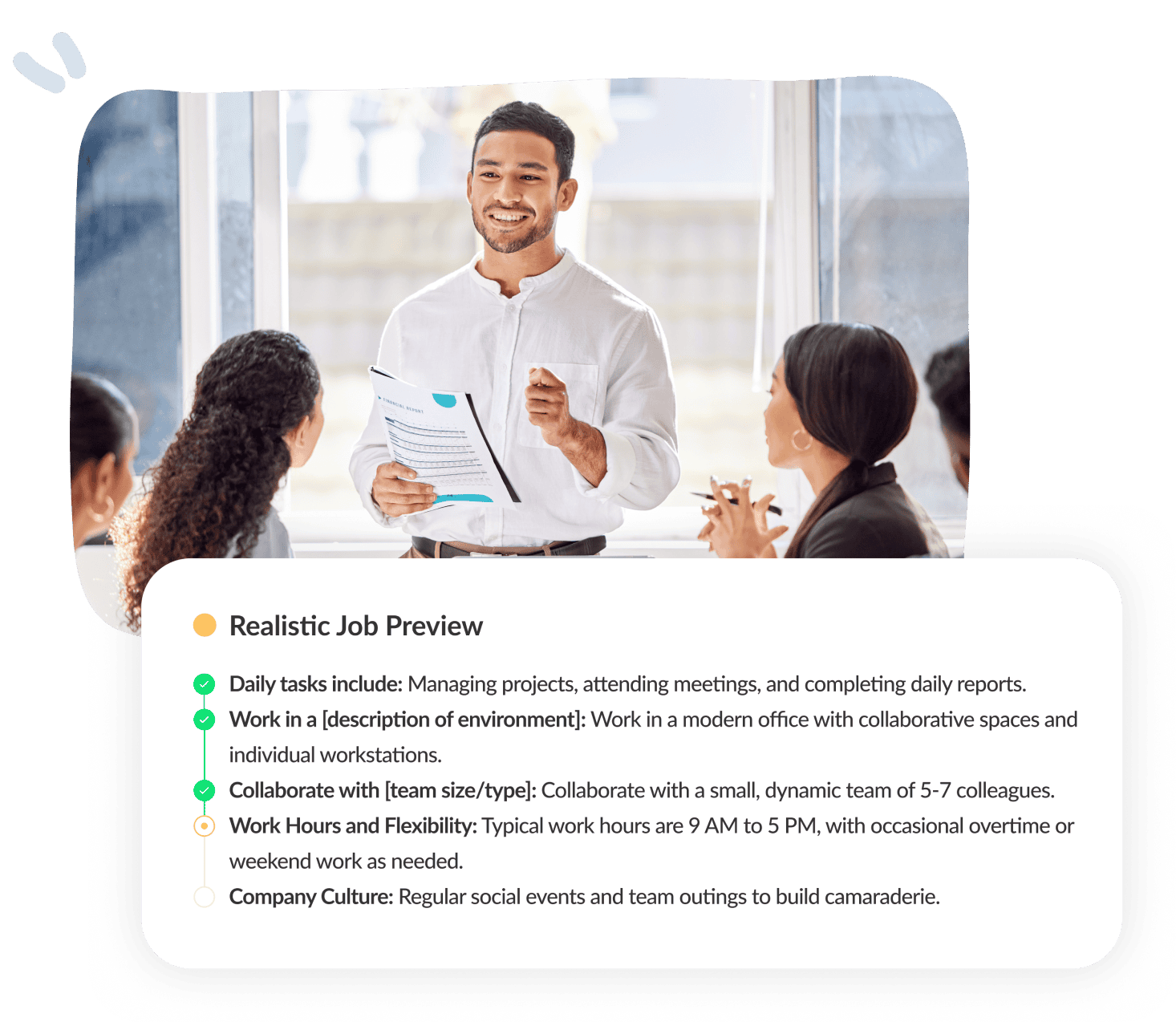
A realistic job preview differs from a job ad in one respect: it shows the full picture, not only the appealing parts. A traditional advertisement is built to sell the position, highlighting perks, growth, and the strengths of the organization. A preview keeps those positives but adds the realities a new hire will face, such as tight deadlines, shift work, or demanding customers.
That honesty changes who applies. A polished ad widens the funnel; a preview narrows it to people who understand the trade-offs and want the role anyway. Both have a place. The ad draws attention, and the preview qualifies interest, which is why many teams run them together rather than choosing one.
A strong realistic job preview covers five areas, each described plainly enough that a candidate can picture the day-to-day.
Teams that use an interview scorecard can tie these same performance expectations to the criteria used to evaluate candidates, so what an applicant is told matches how they are later assessed.
A realistic job preview can take several formats, and most organizations combine a few based on the role and hiring volume.
Written summaries. A balanced written preview, often built into the job description, is the most common format. It is easy to standardize and update, though it can read as less vivid than other options.
Video and multimedia. Short videos bring a role to life through footage of real tasks, workplace tours, and current employees describing the work. Organizations that already use video interview software can host preview videos on the same platform. With pre-recorded video interviews, candidates can watch the preview first and then record answers to set questions, which keeps the experience consistent from preview to evaluation.
Interactive simulations. Role-play scenarios or sample tasks let candidates try elements of the job, such as handling a mock customer query or navigating a software tool. Simulations are realistic but resource-intensive to build.
Job shadowing and live discussions. Shadowing an employee, or talking with future colleagues, gives direct exposure to the real work. For remote teams, live video interviews offer a similar window into team dynamics without an on-site visit.
Task-based previews. A short assignment, paired with skills testing, validates ability while giving applicants a genuine taste of the work. It provides a fast reality check, though it can deter qualified but hesitant candidates.
The benefits of a realistic job preview show up across the recruitment funnel and well into a new hire's first year.
Previews also shift attention from surface impressions to honest job fit, which helps address the impact of hiring biases rooted in first impressions. Centralizing preview delivery and evaluation in an interview management system lets hiring managers see which candidates engaged with preview materials and how that tracks against later outcomes.

The clearest realistic job preview examples come from high-volume, customer-facing roles, where the gap between expectation and reality drives most early turnover. Below are two short previews you can adapt.
Example 1: Customer service representative. The role involves answering calls, resolving complaints, processing orders, and updating records across several systems.
This pattern fits many contact centers, where an honest preview attracts for people who are comfortable with the pace before they start.
Example 2: Warehouse associate. The role involves picking and packing orders, operating equipment, and meeting hourly throughput targets.
A short set of self-reflection prompts can accompany either preview: Am I comfortable with this pace and these hours? How do I handle pressure and repetitive work? Can I adapt quickly to new tools?

You create a realistic job preview in five steps, working from accurate role information rather than the polished version in a job ad.
A simple realistic job preview template helps teams stay consistent: one section each for duties, environment, expectations, compensation, and honest challenges, plus a short list of self-reflection questions for the candidate.

VidCruiter helps teams deliver realistic job previews using the same tools they already use to interview and evaluate candidates. Preview videos can sit on the same platform as pre-recorded video interviews, so a candidate watches the honest preview and then records structured responses in one continuous flow.
For roles that benefit from a hands-on preview, skills testing gives applicants a genuine sample of the work while validating ability. Pairing previews with structured interviews keeps every candidate's experience consistent, and interview scheduling software keeps the process moving once a candidate opts in. VidCruiter is one option among several, and it fits best for teams hiring at volume or across distributed locations.
Request a demo to see how previews fit into a full hiring workflow.

RJP stands for realistic job preview, a recruitment tool that gives candidates an honest, balanced view of a role before they accept it. Unlike a standard job ad, an RJP shares both the rewarding parts of the work and the genuine challenges, such as workload, shift patterns, or difficult interactions. The aim is accurate expectations and a better match between the person and the job.
Yes. Research has linked realistic job previews to lower voluntary turnover, particularly among new hires, because expectations are managed before the offer rather than discovered afterward. When people accept a role knowing its demands, they are less likely to leave in the first months. Lower early attrition then reduces the cost of recruiting, onboarding, and training replacements.
Present challenges plainly and in context rather than dramatizing or hiding them. Describe the demand honestly, then note what makes it manageable or worthwhile, such as support, training, or growth. For example, instead of "the workload is heavy," explain that the pace is steady and gives people fast, visible chances to develop. Honesty filters out poor fits while keeping candidates who want the real role.
A candidate should see the preview early, ideally before or during the application, helping them make an informed decision before anyone invests significant time. Placing it up front means people who are not suited can step away, and those who continue do so with clear eyes. Some teams also revisit key points later in the process to reinforce expectations before an offer.
Review a realistic job preview at least once a year, and sooner if the role or organization changes. Duties, tools, schedules, and team structure all shift over time, and an outdated preview undermines the trust it is meant to build. A quick annual check against what is currently true about the job keeps the content accurate and useful.
No, though high-turnover and high-stress roles see the clearest gains. Any role with a real gap between how it looks and how it feels day to day benefits from an honest preview, including specialized or senior positions with unusual demands. The preview matters most wherever a mismatch would be expensive to correct.
Yes, and video is one of the most engaging formats. Short clips of real tasks, workplace footage, and current employees describing the work give candidates a vivid sense of the role. Teams already using video interview software can host preview videos on the same platform and connect them directly to the interview stage.
No. A job description defines the role's duties and requirements, while a preview adds an honest account of what the work actually feels like, including its challenges. The two work together: a preview is often built into or attached to the job description so candidates get both the formal scope and the day-to-day reality in one place.
Modernize your hiring process with expert insights and advice.