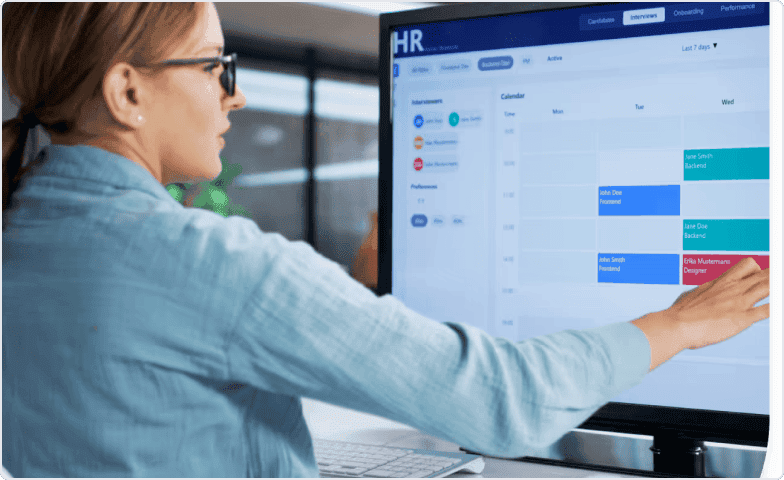


How to Schedule an Interview
A practical guide to scheduling interviews efficiently, from coordinating availability to confirming candidates and reducing no-shows.
Written by
VidCruiter Editorial TeamReviewed by
VidCruiter Editorial TeamLast Modified
May 26, 2026
SHARE THIS ARTICLE


TL;DR Interview Scheduling Problems
Interview scheduling problems cost hiring teams time and money, but most importantly, they repel top candidates. Most of the coordination friction is caused by the manual back-and-forth of trying to find a suitable interview time.
As a solution, VidCruiter's interview scheduling software offers automated self-scheduling, real-time calendar sync, and structured workflows that keep hiring moving at any scale. Candidates experience a smooth hiring process and employers find their talent faster.
Interview scheduling problems are any type of delay or coordination failure that slows down the process of arranging interviews between candidates and hiring teams.
These problems happen when recruiters’ tools, processes, or resources don’t keep pace with the demands of modern hiring. The results are:

Manual interview scheduling depends on a chain of emails and phone calls:
If one party requests a change, it restarts the process. Across a full hiring pipeline, this administrative load adds up to a significant portion of a recruiter's working week.
Multiple hiring stakeholders create more opportunities for scheduling delays. A panel interview requires every participant's calendar to align, and a single unresponsive hiring manager can stall the entire process.
A slow scheduling process loses job candidates. 25% of candidates have ghosted an employer during the hiring process, with poor communication and negative hiring experiences among the most common reasons they disengage.
When candidates wait days for a confirmed interview slot, they keep applying and interviewing elsewhere.
No-shows can waste an entire day of hiring activity. Adrienne Simmons, Human Resources Manager at Kaw Valley Greenhouses, has experienced this first-hand:
Once I drove to Lincoln Nebraska, booked a $175 meeting room, and literally every single applicant no-showed that day. I sat in a room from 9 am to 4 pm and interviewed nobody.
For teams running high-volume hiring across multiple locations, no-shows reset the clock on filling a role. They extend timelines and increase pressure on an already stretched recruiting team.
Global and distributed hiring teams working across multiple locations or time zones struggle with manual scheduling more than most.
Example: A recruiter in Toronto coordinating an interview with a candidate in London must account for:
Every miscalculation means apologizing for a missed interview and another round of coordination to rebook.
Organizations in regulated industries, or those subject to equal employment opportunity (EEO) requirements, must demonstrate they treated every candidate consistently throughout the hiring process.
But when manual scheduling happens across email threads, phone calls, and spreadsheets, there’s no central record. Without a system that auto-logs scheduling activity, it’s impossible to detect or prove that candidate treatment is fair and consistent, which results in compliance gaps.

Interview scheduling bottlenecks slow down every stage that follows.
Manual interview scheduling is the process of coordinating interview times through direct communication between recruiters, hiring managers, and candidates. Every step requires human input, and every change requires another round of communication, using email, phone calls, or calendar invites sent back and forth.
Automated interview scheduling uses software to handle coordination without manual intervention. Recruiters define their availability and parameters upfront. The system manages candidate-facing booking, confirmations, reminders, and rescheduling, without recruiter involvement.
Manual scheduling
Automated scheduling
Speed
Confirming a single slot requires back-and-forth communication
Candidates select from available slots and receive instant confirmation
Time zones
Recruiters calculate and communicate time differences manually, which is error-prone
The platform identifies each candidate's location and displays slots in their local time
Recruiter workload
Every interview requires active recruiter involvement
Availability is configured once; the platform manages all candidate-facing coordination
Scheduling errors
Manual processes create opportunities for double-bookings and missed interviews
Live calendar sync means availability is always accurate and conflicts are prevented
Candidate experience
Candidates can only arrange interview times when a recruiter is available to respond
Candidates can self-schedule interviews, including outside standard working hours
Rescheduling
Candidates must contact the recruiter and restart the coordination process
Candidates return to their booking link and reschedule without recruiter involvement
No-shows
Without automated reminders, candidates are more likely to miss or forget their interview
Automated confirmations and reminders keep candidates informed ahead of their interview
Scale
Scheduling capacity is limited by the number of recruiters available
A single recruiter can run hundreds of scheduling processes simultaneously
VidCruiter's interview scheduling automation provides a direct fix to every common interview scheduling problem.
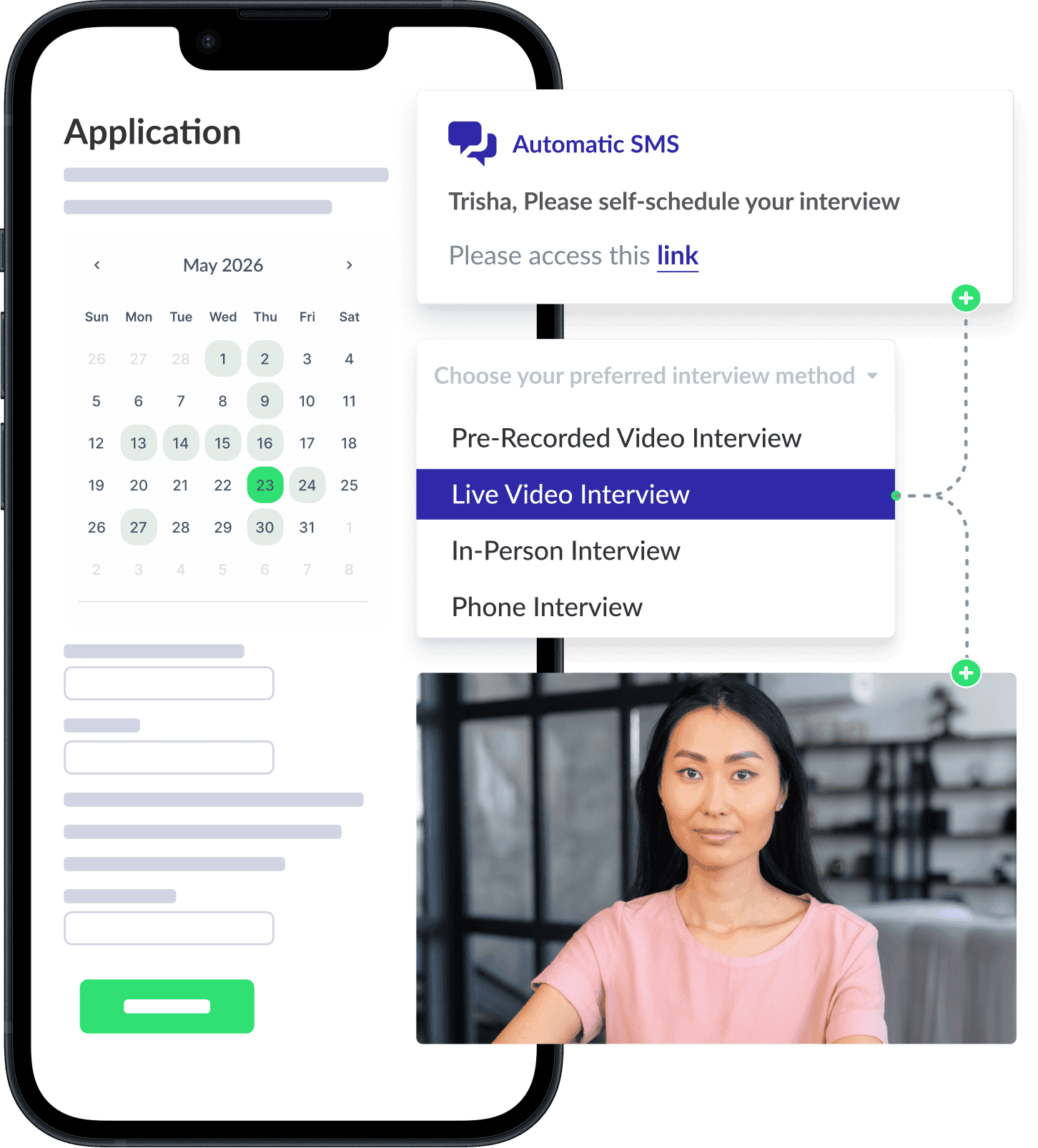
Using VidCruiter, recruiters share a booking link and candidates receive an instant confirmation after selecting from pre-approved slots.
Automated scheduling reduces no-shows through immediate booking confirmations and timed reminders sent by email or SMS ahead of the interview. Candidates who self-select their interview time are also more likely to attend.
Kaw Valley Greenhouses automated its interviews with VidCruiter, contributing to:
Automation handles the coordination but AI makes the process smarter. In VidCruiter:
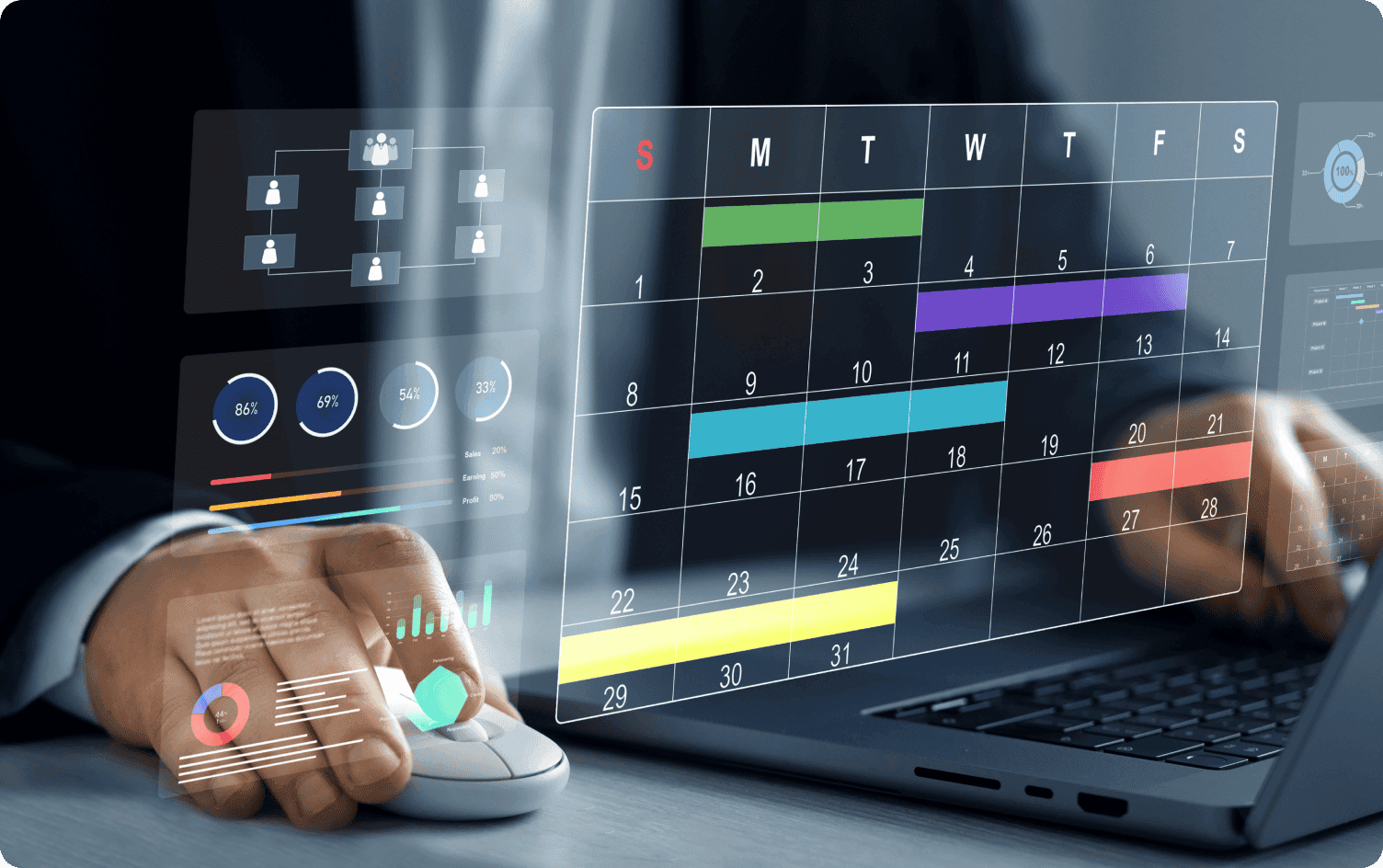
Automation connects your calendar to your scheduling software, giving you visibility into available interview slots in real time.
VidCruiter syncs directly with Google Calendar and Microsoft Outlook, and integrates with leading applicant tracking systems (ATS). The platform captures all scheduling activity within the same system as your broader hiring process.
In-person, remote, and hybrid interview formats are all supported, with scheduling adapting to the interview type and location.
Coordinating interviews across time zones manually is error-prone. VidCruiter’s automatic time zone detection removes this risk entirely.
Structured, automated workflows prevent candidates from stalling between hiring stages. Here’s how VidCruiter removes the dependence on recruiters manually triggering the next step.
At Prospect Schools, this approach contributed to a 50% reduction in recruiter admin time, with scheduling identified as one of the primary manual tasks eliminated.
Manual scheduling leaves no central record of what was communicated, when, and to whom. VidCruiter overcomes interview compliance risks by logging every scheduling action automatically.
Feature category
Description
Automation and workflow management
Automated scheduling based on interviewer availability; workflow triggers that advance candidates automatically; no more back-and-forth emails
Candidates select their own interview time; real-time sync with Google Calendar and Outlook; automatic time zone detection
No-show reduction
Automated email and SMS reminders; instant booking confirmations; candidate-led rescheduling
High-volume hiring
Bulk scheduling across hundreds of candidates; panel and multi-stage coordination; scales across departments and locations
AI and intelligence
Optimal time matching; predictive no-show signals; smart scheduling suggestions
Structured hiring
Scheduling tied to hiring workflows; scorecards linked to each interview; centralized pipeline dashboard
Compliance and auditability
Full audit trails; compliance logs; consistent scheduling processes across teams
Reliability and performance
Real-time availability syncing; no double-bookings; consistent system uptime
Hybrid hiring support
In-person, remote, and hybrid scheduling; location and room booking
ATS integrations
ATS integrations; Google Calendar and Microsoft Outlook
Interview scheduling software is most effective when it is built into a structured hiring workflow, not bolted on as a standalone tool. When scheduling triggers are connected to stage progressions and evaluations, the entire process moves faster and with less manual oversight.
Completed interviews trigger the next hiring stage automatically
Candidates receive their next booking link as soon as they’re ready to progress
Hiring managers receive scorecards and evaluation prompts at the right moment
Recruiters maintain visibility across the entire pipeline from a single dashboard
"Volume recruiting is just a different ball game, and many of our processes were manual and time-consuming. Recruiters simply didn't have enough hours in the day to properly vet all applications, schedule and conduct the number of interviews needed, and complete their administrative tasks consistently. We knew there was a better way."
VidCruiter is an enterprise interview scheduling platform trusted by hiring teams across the public and private sector. Rated 4.8 out of 5 on G2, it uses self-scheduling and automated reminders alongside structured workflows and full audit trails to remove any hint of coordination friction that slows down hiring,
If interview scheduling is creating bottlenecks in your hiring process, request a VidCruiter platform demo to get your pipeline moving.
Interview scheduling slows down hiring when it relies on manual coordination, such as emails, phone calls, and calendar checks that take days to resolve. Every round of back-and-forth delays the process, giving candidates time to disengage or accept another offer.
Yes, interview scheduling software supports high-volume hiring by allowing a single recruiter to manage hundreds of concurrent scheduling processes simultaneously. Bulk scheduling, automated reminders, and workflow triggers keep large candidate pipelines moving without adding recruiter workload.
Self-scheduling improves the candidate experience by giving candidates control over their own interview time. Rather than waiting on a recruiter to confirm a slot, candidates book instantly from pre-approved availability, including evenings and weekends, and receive an immediate confirmation.
Interview scheduling tools coordinate interviews across multiple stakeholders by syncing availability across all interviewers in real time. Candidates only see slots that work for the entire panel, eliminating the need for manual calendar checks across multiple hiring managers.
Modernize your hiring process with expert insights and advice.