

How To Conduct a Structured Interview
Learn how to conduct structured interviews effectively with our comprehensive guide.
Written by
VidCruiter Editorial TeamLast Modified
Jan 29, 2026
SHARE THIS ARTICLE


TL;DR What You Need To Know About AI Interview Support
Artificial intelligence is becoming increasingly common in recruitment, but its role in hiring is often misunderstood. For many HR and talent acquisition teams, AI raises valid concerns about bias, transparency, and the risk of removing human oversight from one of the most critical decisions an organization makes. At the same time, hiring teams are under pressure to move faster, document decisions more thoroughly, and create fair, consistent interview processes at scale.
When used thoughtfully, AI doesn’t replace human decision-making in interviews. Instead, it supports it. By handling time-consuming administrative tasks such as interview scheduling, transcription, and structured note-taking, AI gives recruiters and interviewers more time to focus on what matters most: listening, evaluating candidates holistically, and making informed decisions grounded in complete and accurate information.
This guide explores how AI can support interview scheduling and scoring to strengthen, rather than undermine, human judgment. By focusing on AI as an enablement tool, not an evaluator, we will share practical, ethical applications that improve efficiency, consistency, and documentation while keeping people firmly in control of hiring decisions.
Hiring today is a volume problem.
Across industries, employers received an average of 180 applicants per hire in 2024, according to the 2025 Recruiting Metrics Report, which analyzed data from over 60,000 small businesses and more than 10 million applications.
The rush of candidates makes it difficult for recruiters and hiring teams to move quickly while still giving candidates a fair, thoughtful experience. Reviewing applications, coordinating interviews, and documenting feedback all take time, and those administrative demands can easily crowd out the more human parts of hiring.
AI can play a supporting role for overwhelmed hiring teams. AI doesn’t replace human intelligence, judgment, or accountability in hiring decisions. It cannot understand team dynamics, assess culture fit, or weigh nuanced interview responses in context. Those responsibilities remain firmly with recruiters, interviewers, and hiring managers.
Instead, AI helps teams manage scale. By assisting with tasks such as scheduling interviews, capturing complete interview transcripts, and organizing notes, AI reduces friction in the process. Delegating these tasks allows humans to focus less on logistics and more on listening, evaluating candidates consistently, and making informed decisions.
Interview scheduling is one of the most time-consuming and frustrating parts of the hiring process. Even when everything goes smoothly, coordinating a single interview usually requires multiple emails to find a time that works for both parties. When you are scheduling ten or more interviews, that quickly turns into dozens of messages, calendar checks, and follow-ups.
The complexity increases when hiring managers or panel interviews are involved. Recruiters are often coordinating across multiple calendars, time zones, and last-minute changes, creating unnecessary delays and a disjointed candidate experience.
Candidates today expect faster responses. In a 2024 industry survey of 12,000 job seekers across Europe and North America, about 21% expected interview scheduling within 2–6 days, and nearly 30% expected it within a week before disengaging from the process. Notably, 57% prefer an automated scheduling system to lengthy back-and-forth, underscoring the value of streamlining this step.
expected interview scheduling within 2–6 days
expected it within a week before disengaging from the process
prefer an automated scheduling system to lengthy back-and-forth
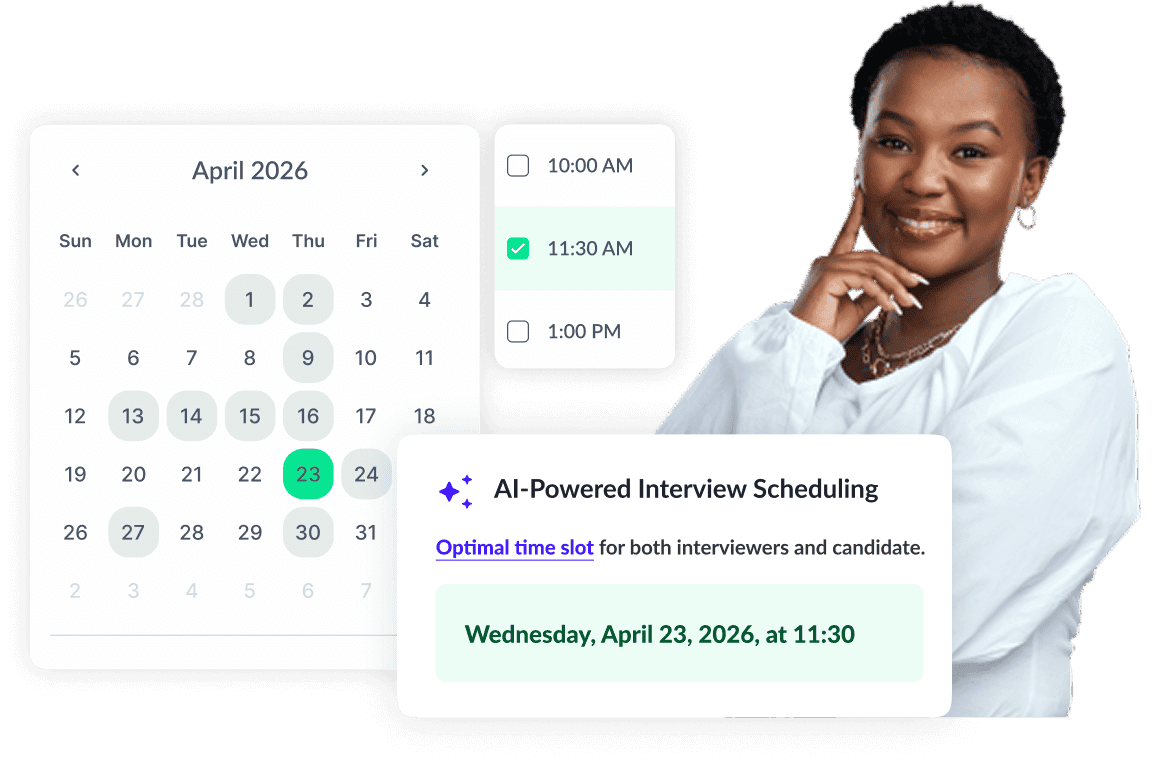
AI-powered interview scheduling tools help streamline this process by automating availability matching, managing calendar updates, and handling rescheduling without manual intervention. By reducing back-and-forth coordination, AI reduces administrative friction and enables recruiters and hiring teams to focus on preparation, candidate engagement, and higher-quality conversations.
Interviews often rely heavily on memory. After a conversation ends, interviewers may remember how a candidate made them feel, the overall tone of the discussion, or a standout moment, but not the exact words, examples, or stories that were shared. Over time, those impressions can blur, especially when multiple candidates are interviewed back-to-back.
AI-powered transcription helps anchor interview feedback in what was actually said. By creating a complete, searchable record of each interview, AI allows recruiters and hiring managers to revisit candidate responses without relying solely on notes or recollection. This shifts evaluation away from vague impressions and toward concrete examples and evidence shared during the conversation.
Traditional transcription methods are slow and impractical at scale. Relistening to a thirty-minute interview to capture details takes time most teams do not have. AI transcription removes that barrier by automatically generating accurate interview transcripts, making it easier for teams to review responses, compare candidates, and support decisions with clear documentation.
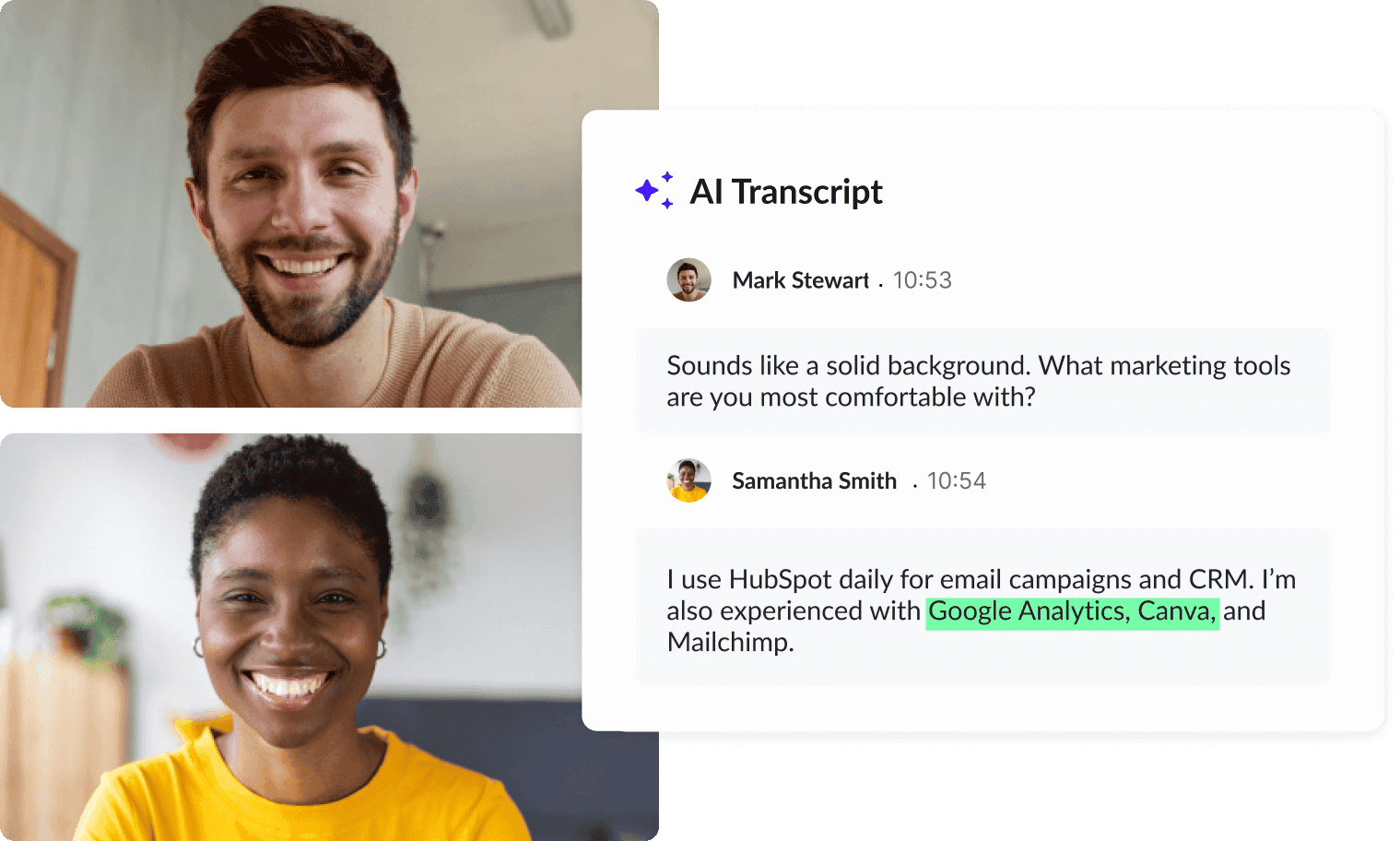
Interview scoring should always be a human responsibility. AI can support that process by making interview information easier to review, reference, and apply consistently. AI interview notes help ensure that scoring is based on what candidates actually shared.
By organizing interview transcripts into structured notes, AI helps surface relevant details tied to predefined scoring criteria. For example, if a role requires strong digital marketing skills, recruiters or hiring managers can quickly review where candidates discussed campaign strategy, analytics tools, or cross-channel experience.
Surfacing insights from an interview doesn’t involve AI assigning scores or making judgments. It simply makes it easier for humans to locate and evaluate the information they need during skills-based hiring.
This kind of support is especially valuable when multiple interviewers are involved. Shared notes and transcripts give everyone access to the same source material, reducing inconsistencies caused by incomplete notes or subjective recall. Human evaluators can then apply their own judgment using a more complete and accurate record of each interview.
Clear, consistent documentation is critical to fair and effective hiring, but it is often difficult to maintain when teams are moving quickly or interviewing at scale. AI-supported interview documentation helps hiring teams capture, organize, and reference interview information more reliably without adding manual work or removing human decision-making.
Improved Consistency Across Interviews
AI-supported documentation helps ensure that interviews are consistently recorded and summarized. When every conversation is captured through transcripts and structured notes, hiring teams can review candidates using the same source material rather than relying on varying note-taking styles or memory. This creates a more level evaluation process, especially when comparing candidates across multiple interviews.
Better Collaboration Among Hiring Teams
When interview documentation is centralized and easily accessible, recruiters, hiring managers, and panel members can collaborate more effectively. AI-generated notes allow team members to review interviews they did not attend and align on feedback using shared context.
According to Aptitude Research, 65% of candidates experience inconsistent communication during the hiring process. If hiring managers and recruiters have consistent documentation and understanding of each candidate, communication issues can be reduced dramatically.
Stronger Documentation for Compliance and Accountability
Comprehensive interview records also support compliance and transparency. AI-supported documentation creates a clear audit trail of interview conversations and evaluation criteria, which can be valuable when responding to internal reviews or external inquiries. Having accurate records helps organizations demonstrate that hiring decisions were made thoughtfully.
Concerns about bias in AI are real and well-documented. High-profile examples and research have shown how poorly designed or improperly trained AI systems can reflect or amplify existing biases related to gender, race, age, or socioeconomic background, particularly when used for evaluation or screening. This growing scrutiny has been widely covered by outlets such as The Wall Street Journal, Business Insider, and Forbes.
For hiring teams that prioritize fairness, equity, and inclusion, these stories naturally create hesitation around adopting AI tools in the interview process.
When used responsibly, AI can help reduce interview bias by improving structure and documentation rather than making judgments. Interview transcripts and AI-supported notes create a more complete record of what candidates actually said, helping shift evaluations away from vague impressions or “gut feelings” that are more susceptible to unconscious hiring bias.
AI also supports fairness by promoting consistency. When every interview is documented in the same way, candidates are more likely to be evaluated using comparable information. This does not eliminate bias nor replace human responsibility. Instead, it gives hiring teams better tools to reflect on their decisions, identify inconsistencies, and apply scoring criteria more thoughtfully and transparently.
Two-thirds of applicants say they accept offers because of a positive hiring experience, and more than a quarter reject offers due to poor communication, which underscores why companies must collect the correct information to give candidates the experience they deserve.
Used as a support mechanism rather than a decision-maker, AI can strengthen fair hiring practices by reinforcing structure, documentation, and accountability while leaving judgment firmly in human hands.

Successful use of AI in interview scheduling and documentation depends less on the technology itself and more on its implementation. The goal is to support recruiters and hiring teams without introducing confusion, risk, or unintended bias. The following best practices help ensure AI remains an enablement tool rather than a decision-maker.
As AI becomes more integrated into interview workflows, legal and ethical responsibilities become even more critical. Hiring teams must ensure that efficiency gains do not come at the expense of candidate rights, transparency, or trust. Privacy, consent, and data protection should be foundational to any AI-supported interview process.
Candidates should always be informed when interviews are recorded, transcribed, or supported by AI tools. Clear communication about how interview data will be used, stored, and reviewed helps set expectations and reinforces trust in the hiring process. Consent should be explicit, documented, and easy to understand, especially in jurisdictions with stricter data protection regulations.
From a compliance perspective, strong documentation can be an advantage when paired with responsible governance. Accurate interview records support fair evaluation and provide clarity if decisions are ever questioned.
At the same time, organizations must ensure secure data handling, limited access, and compliance with applicable regulations, including EEOC guidance and emerging AI laws. Ethical AI use in hiring isn’t about removing humans from the process. It’s about creating transparent systems where human judgment remains accountable and well supported.
The future of AI in interview management is not about automation replacing human oversight. It is about creating hiring processes that are more organized, consistent, and humane at scale. As applicant volumes grow and expectations around fairness and transparency increase, hiring teams will need better support systems that help them focus on meaningful evaluation rather than administrative work.
AI will continue to play a supporting role by improving scheduling efficiency, preserving complete interview records, and strengthening documentation for human review. When implemented thoughtfully, these tools help hiring teams make better-informed decisions while maintaining accountability, compliance, and trust. The most effective interview processes will be those where AI works quietly in the background, empowering people to do what they do best: listen, evaluate, and hire with intention.
AI supports interview scoring by improving access to information, not by evaluating candidates. Transcripts and AI-generated notes make it easier for human reviewers to reference specific examples, compare responses against predefined criteria, and apply interview scorecards consistently. All interpretation, judgment, and final decisions remain the responsibility of recruiters and hiring managers.
When used thoughtfully, AI can improve the candidate experience by reducing scheduling delays, minimizing rescheduling friction, and allowing interviewers to stay more engaged during conversations. Clear communication about recording or transcription helps build trust, while smoother logistics create a more respectful and organized interview process.
AI should never make hiring decisions, score or rank candidates, or evaluate subjective qualities such as culture fit or potential. It should not replace interviewer judgment, override human feedback, or operate without transparency and consent. AI’s role should remain limited to administrative and documentation support.
In many regions, using AI for scheduling and documentation is permitted when privacy, consent, and data protection requirements are met. Candidates should be informed when interviews are recorded or transcribed, and organizations must handle interview data securely and in compliance with applicable employment and data protection regulations.
AI-supported documentation creates shared access to transcripts and structured notes, allowing interviewers to review the same source material even if they were not present for every conversation. This improves alignment, reduces reliance on secondhand summaries, and supports more consistent, informed discussions during hiring decisions.
Modernize your hiring process with expert insights and advice.